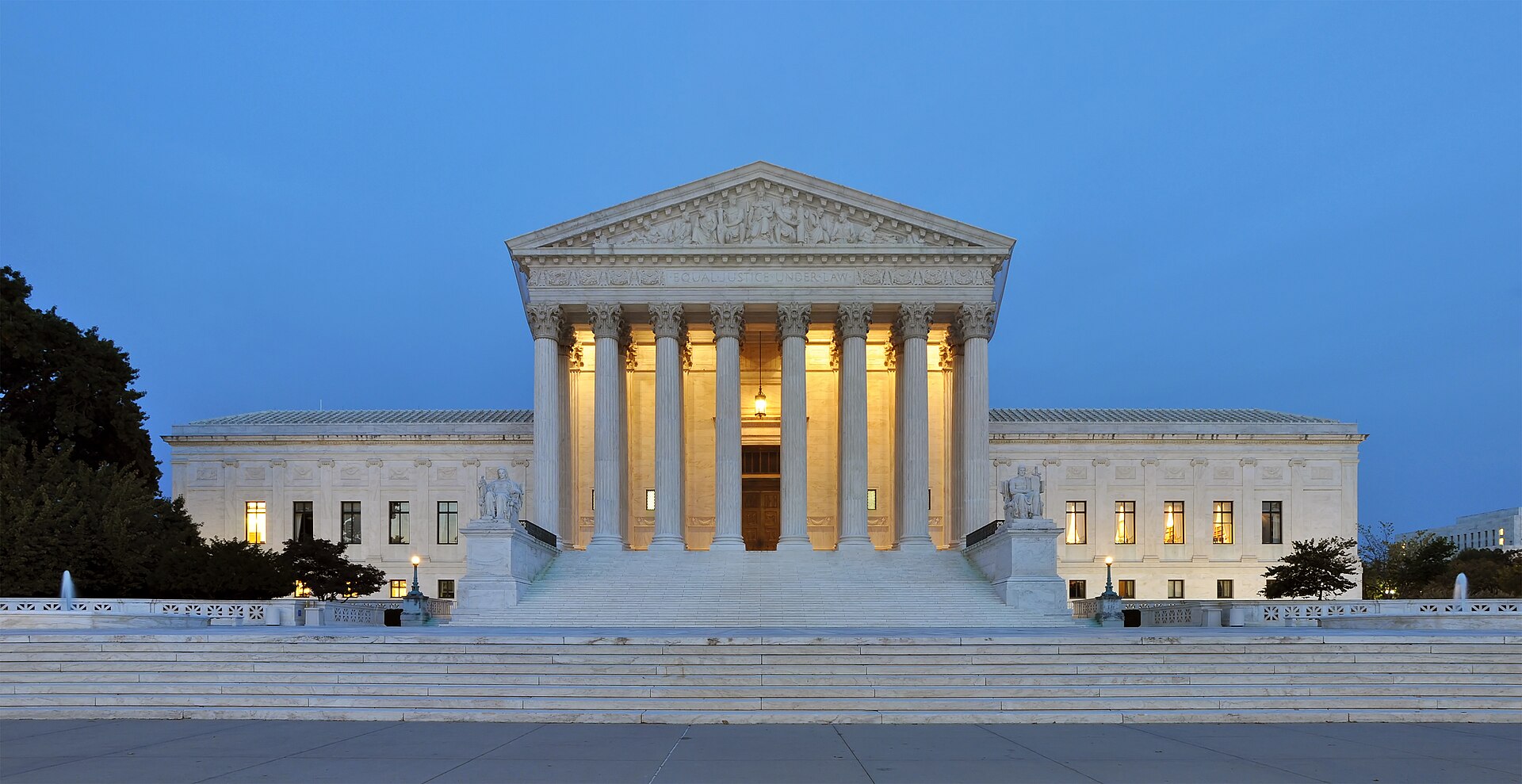
The U.S. Supreme Court Building in Washington. Photo: Joe Ravi / Wikimedia Commons, CC BY-SA 3.0.
A coalition of 130 tribal nations and 15 tribal organizations has asked the U.S. Supreme Court to hear a case over whether prediction-market company Kalshi can offer sports event contracts nationwide without complying with state gambling laws, NJ Gaming Review reported.
The amicus brief, filed Oct. 8, supports New Jersey’s petition in Flaherty v. KalshiEX, docket No. 26-299. The petition was filed Sept. 2, and Kalshi’s response is due Nov. 9, according to the Supreme Court docket and the Native American Rights Fund’s Supreme Court tracking project.
What the lower court decided
In April, the 3rd U.S. Circuit Court of Appeals held that Kalshi’s sports contracts are swaps traded on a market licensed by the Commodity Futures Trading Commission, and that New Jersey’s attempt to regulate them under state gambling law is likely preempted by federal commodities law.
The tribes’ brief argues that the ruling conflicts with decisions from the 6th and 9th circuits, a split that, if the justices agree it exists, is among the most common reasons the Supreme Court takes a case.
Why tribes are involved
For tribal nations, the dispute is about more than one company. Tribal gaming operates under the Indian Gaming Regulatory Act, a 1988 federal law that, together with tribal-state compacts, governs where and how gaming may be offered. Tribes have built extensive regulatory systems under that framework. According to the brief, tribes spend more than $450 million a year on gaming regulation and employ more than 6,000 regulators.
If contracts on the outcome of sporting events can be sold nationally as federally regulated derivatives, the tribes argue, the market exclusivity and regulatory structure that Congress and the states negotiated with tribal nations could be bypassed entirely.
“This state of affairs is unacceptable,” the brief states, calling it “an affront to tribal sovereignty, an end-run around Congress and the States.”
How tribal gaming law works
The modern framework dates to 1987, when the Supreme Court held in California v. Cabazon Band of Mission Indians that states could not enforce their gambling regulations on tribal lands. Congress responded the next year with IGRA, which divides gaming into three classes. Casino-style Class III gaming, which includes sports betting, is allowed only under a compact negotiated between a tribe and its state and approved by the Interior Department.
After the Supreme Court struck down the federal ban on state-authorized sports betting in Murphy v. NCAA in 2018, states and tribes began renegotiating compacts to include it. In several states, tribes secured exclusive or leading roles in sports wagering in exchange for revenue sharing.
A nationwide market in sports event contracts that no state can regulate would sit outside that entire structure. The National Indian Gaming Commission reported that tribal gaming generated $46.2 billion in gross revenue in fiscal 2025, money that by law must fund tribal governments, programs and economic development.
The other side
Kalshi has argued that its contracts are lawful financial instruments listed on a federally designated exchange, and that Congress gave the CFTC exclusive jurisdiction over such markets. The 3rd Circuit agreed that this argument was likely to prevail.
That position has drawn support from those who see prediction markets as legitimate tools for pricing risk and who argue that a patchwork of state gambling rules should not govern a federally supervised exchange.
What comes next
The justices will consider whether to grant review after Kalshi files its response. If they take the case, it could be argued and decided by the end of the term next year. A ruling in Kalshi’s favor would have implications far beyond New Jersey, affecting state gaming regulators and tribal governments in every state where tribes operate under compacts.
The stakes for tribes are economic as well as legal. Gaming revenue funds tribal government services, including health care, housing and education, across much of Indian Country.
Sources: NJ Gaming Review; NARF Tribal Supreme Court Project.