By Ruth Ellery, Tewatati
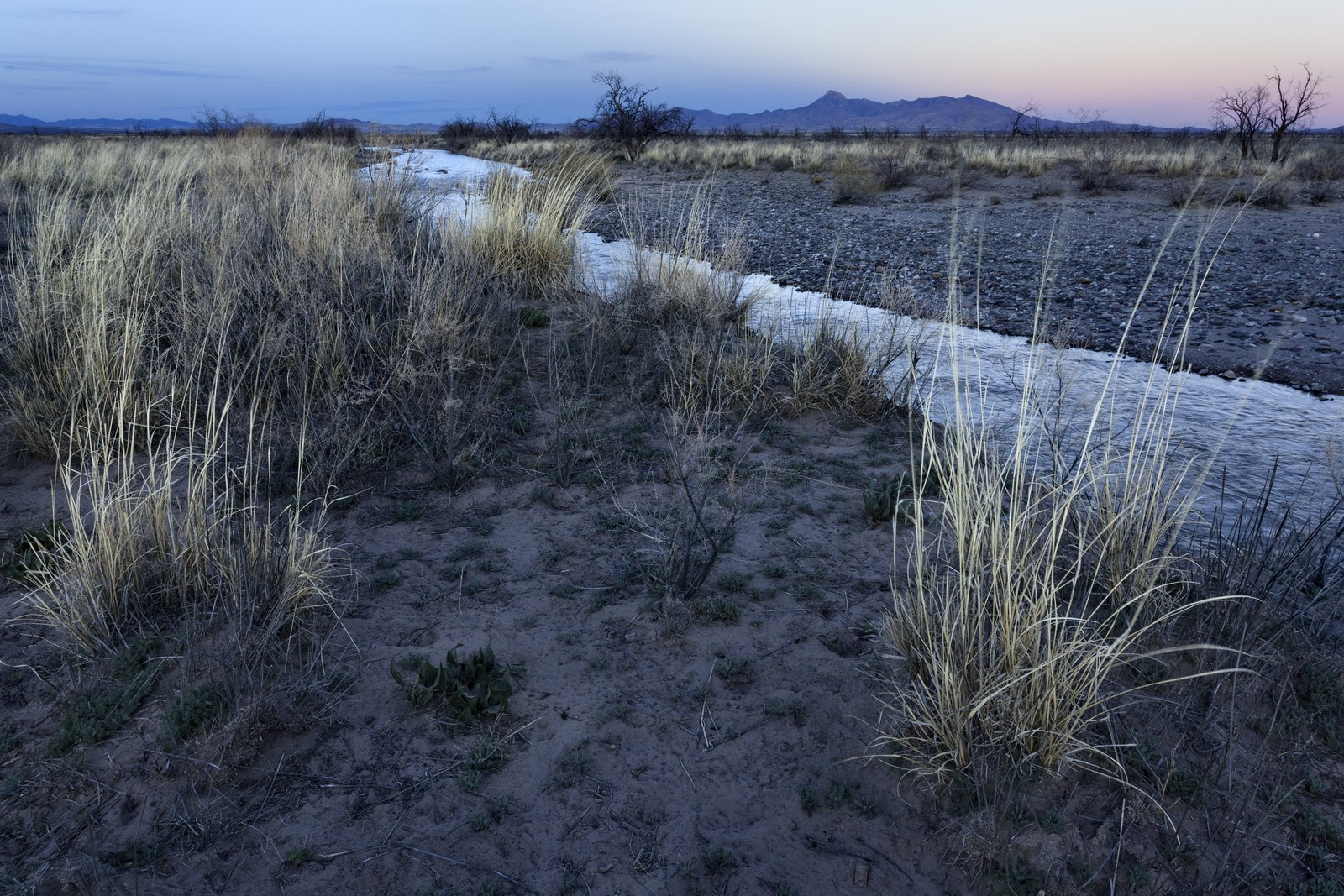
The Mimbres River northwest of Deming, N.M. (2016). Photo: Patrick Alexander / Wikimedia Commons, CC0 1.0 (resized).
Nearly a century ago, University of Minnesota faculty and students took them from their graves in southern New Mexico. This fall, the Mimbres ancestors went home.
Staff from the university and its Weisman Art Museum “accompanied the complete inventory of Mimbres ancestral remains and cultural belongings back to their homelands for a reburial, led by descendant Hopi and Pueblo communities,” the university announced on Oct. 7. The university said its 1928 to 1931 excavations had removed “thousands of Mimbres objects and almost 200 ancestral remains.”
“The Hopi Tribe is grateful to our Pueblo community members for their partnership in completing this sensitive process and is happy to welcome our ancestors back home,” Stewart B. Koyiyumptewa, the Hopi Tribe’s tribal historic preservation officer, said in the announcement.
The university did not say where or when the reburial took place, and Tewatati is not reporting those details. They belong to the descendant communities, who led the ceremony.
A dig, and a long wait
Mimbres communities lived in what is now southwestern New Mexico and neighboring parts of Arizona and northern Mexico. The university dates the material it held to about 1000 to 1150. The excavations were led by Albert Jenks, founder of the university’s anthropology department, The Art Newspaper reported in 2020.
Many of the objects were painted bowls buried with the dead. They “were originally found in or near graves at the Mimbres excavation sites, covering the head of the deceased or stacked up beside the remains,” the Weisman explained in a 2022 FAQ.
The ancestors and their belongings then spent decades in institutional storage. In 1989 the remains were transferred to the Minnesota Indian Affairs Council under state law. The funerary objects, other cultural items and records went to the Weisman in 1992.
Pressure for the return built over years. In 2020, the council said the museum’s repatriation of the funerary objects had been “egregiously delayed due to its refusal to return the objects,” The Art Newspaper reported.
In February 2022, the university’s Board of Regents authorized the repatriation. “We cannot undo our past. We can accept responsibility for it,” then-board chair Ken Powell said.
Ancestors, counted and returned
Under the Native American Graves Protection and Repatriation Act, the 1990 federal law that requires federally funded institutions to return ancestral remains and funerary objects, the university and its partner museums published an inventory in 2023 and amended it in January 2024.
The amended notice counts the remains of 198 individuals and 4,234 funerary objects from sites in New Mexico’s Grant and Catron counties, including the Galaz Ruin and the Cameron Creek and Warm Springs sites. It traces a shared group identity between the ancestors and the Hopi Tribe, the Mescalero Apache Tribe and 19 Pueblo nations in New Mexico and Texas, from Acoma, Zuni and Taos to Ysleta del Sur.
In May 2025, Karen Diver, the university’s senior adviser to the president on Native American affairs, told the regents that the Hopi would lead the return. “They have been sending representatives here, giving us guidance on how to care for their ancestors and funerary objects,” she said, MPR News reported.
That leadership was the tribes’ decision. “It was the tribes who agreed that Hopi would be the leading repatriating tribe,” Susannah Schouweiler, the Weisman’s director of marketing and communications, said in written responses to Tewatati on behalf of the museum. “Consultation always included Hopi and an ad hoc committee of Pueblo representatives, also determined by the tribes.”
“Consultations took place over four years,” she said. “The Weisman was responsive to the Hopi and Pueblo tribes, who were very gracious in advising us on how to care for their ancestors and funerary items. We complied with all tribal requests.”
“All consultations, preparation, and reburial costs have been paid by the University,” the University of Minnesota said in written responses, adding that some expenses are still open, so it has no total yet.
Gathering what was scattered
The university was not the only institution involved in the digs. The 1928 excavations at Warm Springs and Cameron Creek “were a joint venture by the Santa Fe Museum, the Minneapolis Institute of Art and the University of Minnesota,” said John Lukavic, the Denver Art Museum’s Andrew W. Mellon Curator of Native Arts, and Jennie Trujillo, its Andrew W. Mellon Curatorial Fellow of Indigenous Arts of North America. In 1958, they said, the Minneapolis Institute of Art transferred the bowls it held to the university’s anthropology department, which in 1970 exchanged part of the Mimbres material with the University of Colorado Boulder.
“According to our records, 51 Mimbres vessels were transferred to the University of Colorado from the University of Minnesota in 1970,” said Elena Lompe (Lakota), anthropology collections manager and NAGPRA coordinator at the University of Colorado Museum of Natural History. “Following consultation that identified the 51 vessels as funerary objects, the CU Museum of Natural History returned them in 2024 as part of the broader repatriation effort.”
The Denver Art Museum returned one 11th-century ceramic bowl, excavated at Cameron Creek on July 20, 1928, which it received by exchange from the Boulder museum in 1972, Lukavic and Trujillo said. The university also credited the Minnesota Indian Affairs Council, the Science Museum of Minnesota, the Milwaukee Public Museum, the Yale Peabody Museum, the Cleveland Museum of Art and the Museum of Indian Arts and Culture in Santa Fe.
“In recognition of the longstanding harm, the University of Minnesota team aimed to coordinate efforts to pull together the return of as many Mimbres ancestors and belongings from the original excavation as could take place at once,” Schouweiler said.
What remains
“To the best of our knowledge, the Weisman has returned all Mimbres materials from the 1928 to 1931 excavations which were subject to NAGPRA,” Schouweiler said. “We are working with the University of Minnesota Archives to return all the records.” The museum is also reviewing its ceramics collection for NAGPRA compliance, she said.
Asked whether it holds other ancestral remains or cultural items awaiting repatriation, the university said, “Yes. The timelines on these projects are determined solely by the affected Tribes.”
Lompe said the CU museum has “no active NAGPRA inquiries related to this collection.” The Denver Art Museum holds other Ancestral Puebloan objects, Lukavic and Trujillo said. “All affiliated tribes have been notified of the collection, and we continue to consult with them and follow their guidance on the duty of care for these cultural items.”
“I’m thankful their ancestors have now come home and am looking forward to continuing the work of repairing community relationships damaged by this historic harm, and to building something healing and hopeful together in the future,” Weisman director Alejandra Peña Gutiérrez, the university’s project lead for the repatriation, said in the Oct. 7 announcement.
Since 2022, the museum has run what it calls a Truth and Repair initiative, Schouweiler said. “This is work the Weisman is committed to continuing,” she said.
Koyiyumptewa; George J. Goggleye Jr., cultural resource manager at the Minnesota Indian Affairs Council; and the Museum of Indian Arts and Culture did not respond to requests for comment by publication time.
Ruth Ellery writes features and human-interest stories for Tewatati.