By Maya Ferreira, Tewatati
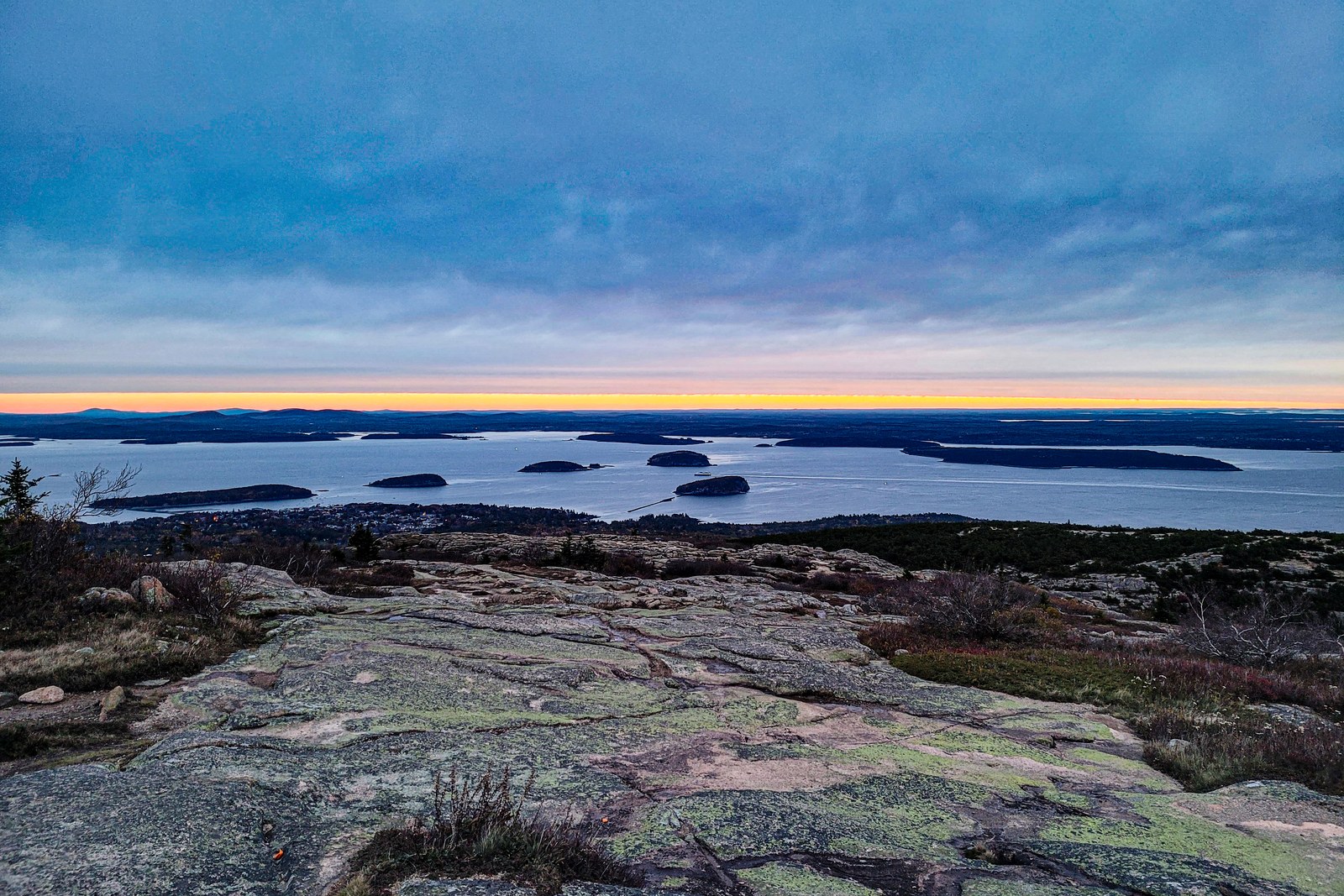
The Wabanaki know the granite summit of Cadillac Mountain in Maine as Wapuwoc, “white mountain of the first light.” From October to March, it is the first place in the continental United States to see the sunrise. Visitors who climb it for the dawn can no longer read the marker that explained the mountain’s sacred significance to the Wabanaki people. “Today, visitors from everywhere find meaning on the mountain,” the sign said.
It was one of 30 markers removed from Acadia National Park under a Trump administration campaign against materials deemed disparaging to American history, according to the National Parks Conservation Association, The Associated Press reported Oct. 22. Park staff took it down on the orders of Interior Secretary Doug Burgum. Acadia draws more than 4 million visitors a year.
Some of the removed signs were developed over years of partnerships with Friends of Acadia, the Schoodic Institute and the Native Plant Trust, with consultation from citizens of the Wabanaki Nations, the AP reported. The Wabanaki Confederacy, made up of the Maliseet, Mi’kmaq, Passamaquoddy, Penobscot and Abenaki nations, has lived along the northern seaboard for more than 10,000 years.
“The good stuff”
For Maulian Bryant, executive director of the Wabanaki Alliance, the loss is about how far the Wabanaki had come in Acadia. “Getting to a place where our language is in these parks and it is educational … erasing that or setting that back has big implications for how far we’ve come,” she told the AP.
Bryant said the removed signs reflected “the good stuff,” not the hardest parts of the history. “These signs don’t say 96% of Wabanaki people died from smallpox, or there were 26 nations and now there’s four,” she said. “If we really want to get into the real history, that’s a whole other slice of cake.”
Penobscot Nation citizen Jennifer Neptune said good signage in national parks is hard won. “It’s a real gut punch when it (removal) happens, not just for Indigenous people, but for Black people, for the people whose stories don’t get shared,” she said.
The removals did not stop at Wabanaki history. Other signs taken from the summit addressed climate change, telling visitors that “Acadia’s future will be warmer and wetter,” the AP reported. In September 2025, Maine Public reported that six signs had come down on the summit and four in the Great Meadow. They covered ecology, climate change and the mountain’s cultural and spiritual significance to the Wabanaki. Interior Department deputy press secretary Aubrie Spady called the removed signage “brainless fear-mongering rhetoric used to steal taxpayer dollars,” the station reported.
Culture that carries on
Wabanaki people have kept bringing their culture onto the mountain anyway. The Abbe Museum in Bar Harbor runs a program with the park that brings Native voices into Acadia through music, arts and culture, the AP reported. As part of it, Nick Bear and members of a Wabanaki drum circle perform on Cadillac Mountain every year. “That’s just like bringing those ceremonies right back to the original sites,” Bear said.
In July, Passamaquoddy basket maker Lydia Soctomah demonstrated ash and sweetgrass basketry outside the park’s Sieur de Monts Nature Center. “Making a basket is worth 1,000 memories for me,” she told the AP. “I was always told it holds a part of your spirit.”
Sweetgrass itself shows what the partnerships built. When Acadia was established in 1916, park rules barred traditional practices such as gathering sweetgrass, the National Park Service said in a July 2024 announcement. In 2017, Suzanne Greenlaw, a citizen of the Houlton Band of Maliseet Indians, led a Wabanaki sweetgrass study with the U.S. Forest Service, the Schoodic Institute and 14 traditional gatherers. “It was really impactful because we had never had those kinds of co-stewardship relationships,” Greenlaw told the AP, adding that those relationships have not changed. In 2024 the park approved a decision allowing the five federally recognized tribes in Maine to enter agreements to gather sweetgrass in Acadia. Acadia Superintendent Kevin Schneider said then that the step would provide “space for Wabanaki citizens to heal and re-connect with their homeland.”
Former National Park Service director Chuck Sams told the AP that the administration’s “attempt to rewrite history into a single narrative … is also counter to our democracy.” He added: “There are always ebbs and flows with every administration. Nobody has seen that more than American Indian tribes.”
Where the case stands
The removals stem from a March 2025 executive order, “Restoring Truth and Sanity to American History,” and Burgum’s Secretary’s Order 3431 of May 20, 2025. The orders called for park materials that “inappropriately disparage Americans past or living” to be replaced, and for content on natural features to focus on “the beauty, abundance, and grandeur of the American landscape,” according to a July 2 order of the 1st U.S. Circuit Court of Appeals.
In February, a coalition of conservation, history and science organizations, including the National Parks Conservation Association, sued in federal court in Massachusetts. On June 12, U.S. District Judge Angel Kelley ordered removed materials restored by July 3, according to the Civil Rights Litigation Clearinghouse. She wrote that the government’s efforts, “ostensibly taken in the name of restoring dignity, instead seek to rewrite the Nation’s history with a white-out pen.”
The 1st Circuit paused that order on July 2, the day before the deadline, the Portland Press Herald reported. Without ruling on the merits, the three-judge panel found the Interior Department had made a strong showing that the lower court erred in finding the plaintiffs would likely suffer irreparable harm. Tewatati found no ruling on the appeal itself in the court records it reviewed.
The case is moving ahead in district court. The government filed the administrative record on Sept. 17, and the plaintiffs’ summary judgment motion is due Dec. 11, according to the docket. The Interior Department did not respond to the AP’s questions about the removals or the lawsuit.
The Abbe Museum, the Wabanaki-centered museum in Bar Harbor, says its answer lies partly outside federal control. “The Abbe Museum continues to collaborate on our Cultural Connections in the Park programming with Acadia,” Betsy Richards, the museum’s executive director, said in an email to Tewatati. “Our greatest opportunity to address the removal of Wabanaki interpretation under Executive Orders is the planned 2028 reopening of the Abbe’s Sieur de Monts location in Acadia National Park for its 100th Anniversary.”
The original museum opened in 1928, and Richards said it “is the only private trailside museum in a National Park and operates outside of Federal oversight.” “We are on track to reopen this trailside museum as a Wabanaki-sanctioned interpretive space that tells the story of the land and the Wabanaki peoples from a first voice perspective,” she said.
Bryant; the Penobscot Nation; the National Parks Conservation Association; the National Park Service; the Interior Department; and the Center for American Progress did not respond to requests for comment by publication time.
Dawn seen from Cadillac Mountain (Wapuwoc) in Acadia National Park, October 2021. Photo: John Manard / Wikimedia Commons, CC BY-SA 2.0 (cropped and resized).
Maya Ferreira covers culture and the arts for Tewatati.