By Victoria Hale, Tewatati
Comanche Nation voters were asked in September whether their leaders should get raises. They said no.
In a special election on Sept. 11 and 12, about 59% of voters chose to keep the chairman’s salary at last fiscal year’s $185,000 instead of adding a 3% cost-of-living increase that would have taken it to $190,550, KOSU reported. About 71% chose to pay the seven-member Business Committee $500 per meeting or work session, capped at 10 a month, rather than $5,000 a month. About 63% kept the tribal administrator’s salary at $120,000. The results took effect Oct. 1, the start of the Nation’s fiscal year.
The vote highlights a question that each tribal nation answers its own way: who decides what elected leaders are paid, and whether citizens can see the figure. Some nations put it to voters, some hand it to a citizens’ panel, some write it into law, and some leave it to the leaders themselves. Many do not publish the figures at all. Sovereign nations have no obligation to disclose pay to outsiders; the issue is how open the process is to their own citizens.
All figures below are salaries reported in public records or news reports. They are not measures of personal wealth, and a nation’s revenue or enterprise income is not its leaders’ pay.
Navajo: let the voters decide
Navajo Nation Council delegates have earned $25,000 a year since 1989, according to Legislation 0232-26, posted for public comment Oct. 6. The bill, sponsored by Law and Order Committee Chair Eugenia Charles-Newton, would send two measures to voters. Measure A would raise delegates’ base salary to $70,000. Measure B would replace the current rule, under which two-thirds of the Nation’s 110 chapters must ratify delegate raises, with approval by referendum.
The increase would raise combined pay for the 24 delegates from $600,000 to $1.68 million a year, the Navajo Times reported. Speaker Crystalyne Curley is listed as co-sponsor. Her deputy chief of staff, Jared Touchin, told the paper that Charles-Newton asked Curley to co-sponsor because she could not travel to Window Rock to sign the bills before legislative deadlines. “It doesn’t mean that she’s supporting the legislation,” Touchin said.
The bill was on the agenda for the Council’s Oct. 19 to 23 fall session (agenda). As of Oct. 27, the Nation’s legislative tracking system listed it as “In Navajo Nation Council (3 of 3).” Tewatati could not find a published record of a final vote. If the Council approves it, the measures would go on the next regularly scheduled Navajo election held at least 60 days later, or on a special election.
Navajo voters have turned down raises before. In 2018, a referendum on raising the president’s and vice president’s salaries failed 18,802 to 37,693, according to unofficial results published by the Navajo Times.
Cherokee: a citizens’ committee
The Cherokee Nation gives the decision to a five-member Citizens Committee on Compensation. In 2022 the committee approved raising the principal chief’s salary from $190,000 to $299,000, then $335,000 and eventually $365,000, the Cherokee Phoenix reported. Principal Chief Chuck Hoskin Jr. said in a statement at the time: “No elected official – not me, Deputy Chief (Bryan) Warner or any member of the Council – voted themselves a pay raise.”
The committee’s latest report, dated June 22, 2026, unanimously found that “no adjustment in elected official compensation is warranted at this time” and put off a market review until 2028. It also said Cherokee officials “remain behind their peers in governmental and private sectors.” An attached human resources memo says councilors’ base pay rose from $63,000 to $99,000 in 2022, reached $121,000 in fiscal 2024, and now rises 3% a year.
Fixed in law, or set by the chief
KOSU’s reporting also covered how pay is set at other Oklahoma nations. Muscogee Nation law fixes the principal chief’s pay at $150,000 a year, and the Osage Nation’s principal chief makes $150,000. At the Choctaw Nation, the constitution lets the principal chief set salaries for elected officials other than the Tribal Council and the courts.
The Chickasaw Nation does not publish its governor’s pay, and the public figures conflict. KOSU, citing the Nation’s administrative code, reported a base salary of $1.2 million with a 5% increase for each year served after Oct. 1, 2019. The Cherokee committee’s 2026 report, citing its 2022 work, says the Chickasaw governor “is paid a minimum of $600,000 plus $50,000 for each elected term.” Tewatati asked the Chickasaw Nation to confirm the current figure.
The Comanche Nation; Justin Lofton of the Chickasaw Nation; Julie Hubbard of the Cherokee Nation; the Osage Nation; Joel Barkin of the Oneida Indian Nation; and the National Congress of American Indians did not respond to requests for comment by publication time.
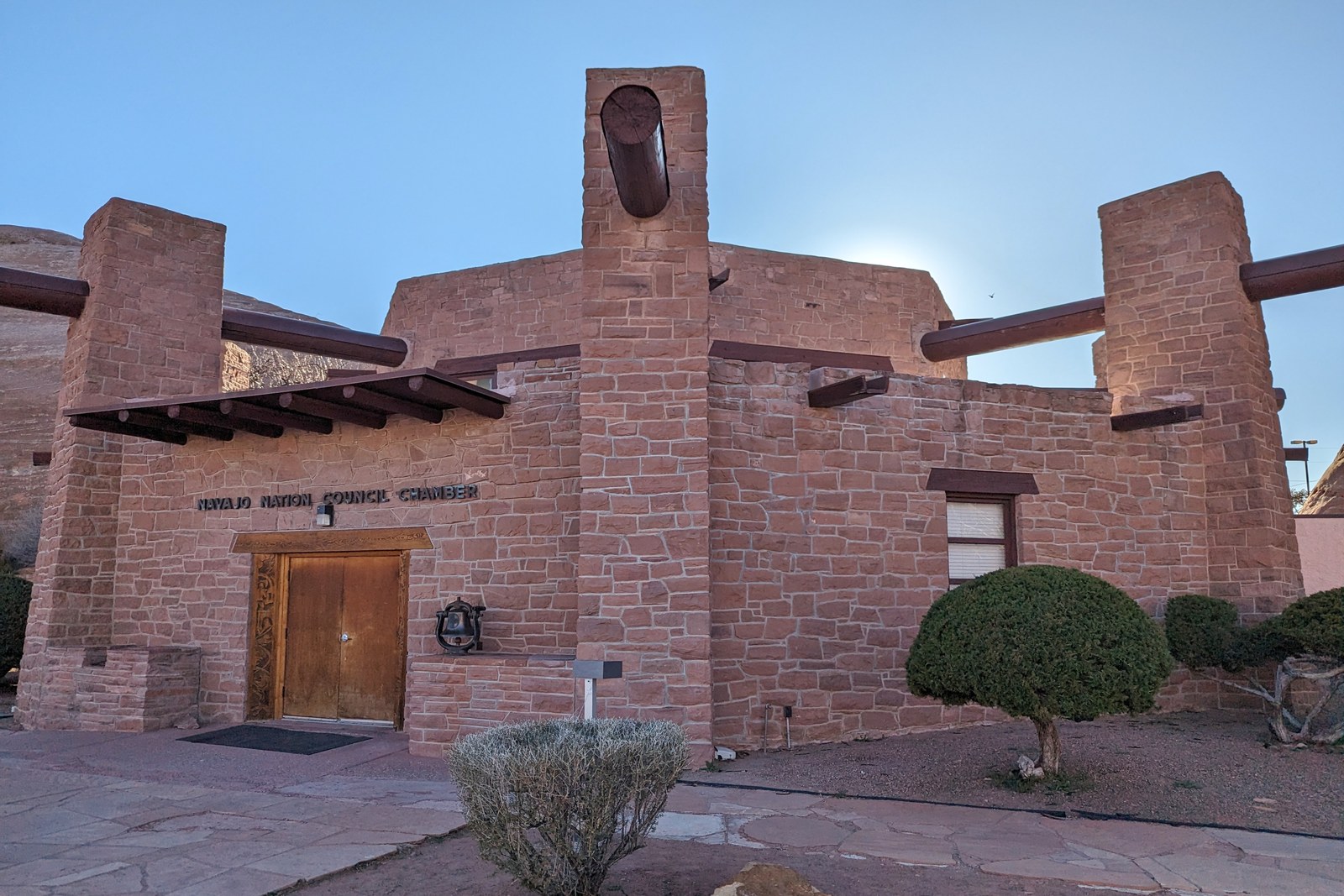
The Navajo Nation Council Chamber in Window Rock, Arizona, April 2024. Photo: SounderBruce / Wikimedia Commons, CC BY-SA 4.0 (cropped and resized).
Victoria Hale covers power, wealth and leadership in Indian Country for Tewatati.