By Henry Calloway, Tewatati
More than a decade after two dams came out of Washington’s Elwha River, the land the federal government acquired to remove them is going to the Lower Elwha Klallam Tribe.
President Donald Trump signed the Lower Elwha Klallam Tribe Project Lands Restoration Act, H.R. 2388, on Oct. 20, according to a White House notice. It is now Public Law 119-128, the National Archives’ list of new laws shows. The law takes about 1,082 acres on the Olympic Peninsula into trust for the Tribe and makes the land part of its reservation.
It is one of several tribal land and water measures Congress sent to the president in September and October, before both chambers left Washington ahead of the Nov. 3 midterm elections.
What the law does
The Senate Committee on Indian Affairs report on the bill (S. Rept. 119-135) lays out the history. In the early 1900s, two dams were built on the Elwha to power Port Angeles and the timber industry. They blocked salmon and trout runs and flooded Indian Valley, cutting the Tribe off from ancestral lands and sacred sites. After the Tribe challenged the dams’ relicensing in the 1970s and 1980s, Congress passed the Elwha River Ecosystem and Fisheries Restoration Act, signed by President George H.W. Bush in 1992, to authorize their removal. The Elwha and Glines Canyon dams came down between 2011 and 2014. The 1992 law also directed the Interior Department to identify lands suitable for transfer to the Tribe, but what would happen to the project lands was never settled.
The new law settles it. The land, now managed by the National Park Service, goes into trust. Gaming under the Indian Gaming Regulatory Act is barred on it, treaty rights under the 1855 Treaty of Point No Point are preserved, and the Interior Department must survey the boundaries. The Congressional Budget Office noted that “the tribe has no stated plan to conduct gaming on that land.”
There are three parcels, according to a release from Sen. Maria Cantwell (D-Wash.). The Park Service acquired 1,061 acres to demolish the two dams. The other two parcels carry a pipeline that supplies water to the Tribe’s House of Salmon hatchery. Cantwell’s release said the Washington State Department of Transportation, the Makah Tribe and the City of Port Angeles supported the bill.
A two-year path through both chambers
Rep. Emily Randall (D-Wash.) introduced H.R. 2388 in March 2025, and Cantwell and Sen. Patty Murray introduced the Senate version, S. 1513, that April, according to the committee report. The House passed the bill by voice vote on Dec. 9, 2025.
At a Senate Indian Affairs hearing on Dec. 17, 2025, the Bureau of Indian Affairs testified: “The Department supports conveying these lands into trust for the Lower Elwha Klallam Tribe.” The committee approved S. 1513 in May 2026. The full Senate then passed the House bill by unanimous consent on Sept. 24, the Peninsula Daily News reported.
“It is a great honor to be trusted to steward these lands again, it continues to be a great part of our healing from the dam removal projects,” Lower Elwha Klallam Chairwoman Melissa A. Gilman said in Cantwell’s release. “We continue to see slow but persistent growth in our river and the return of the salmon.” She thanked Councilwoman Frances Charles, the Tribe’s chairwoman for 22 years, “for her years of persistence.”
Charles said in the same release that the return of the lands “is an important final action to the dam removal project that rewilded the Elwha River and made possible the recovery of the salmon populations.”
Tribal leaders toured the land with national park staff in early October, The Seattle Times reported. The paper reported that it would be the first time the lands have returned to the Tribe since the 1855 treaty, and that the area includes the Tribe’s creation site, which was flooded for a century. “Our land isn’t just land. The river isn’t just the river. The salmon aren’t just salmon,” Gilman told the paper. “This is part of who we are as people.” KNKX reported that the transfer will nearly double the size of the reservation.
“Salmon and steelhead are actively recolonizing historic habitats in the watershed, with early success observed in coho and steelhead. Pink salmon have been returning (during odd years) in consistently increasing numbers,” the Northwest Indian Fisheries Commission, whose 20 member tribes include the Lower Elwha Klallam Tribe, said in an email to Tewatati from communications manager Kari Neumeyer that included comments from Matt Beirne, the Tribe’s natural resources director. “However, it’s important to note that we are still in the early stages of what biologists consider to be a 20-30 year recovery period, depending on species.”
The email called receiving the project lands “a major historic event for which the Tribe waited over 3 decades” and suggested contacting the Tribal Council directly for its perspective.
Quinault bill still needs one more vote
A companion measure for the Quinault Indian Nation did not make it to the president. It would move Allotment 1157, about 72 acres of old-growth forest held by the U.S. Forest Service, into trust for the Nation, according to a December 2025 release from Randall. The land was part of the reservation set aside under the 1856 Treaty of Olympia; the Forest Service bought it in 1996.
The House passed its version, H.R. 2389, on Dec. 9, 2025, the same day as the Elwha bill. The Senate passed its own version, S. 1514, with committee amendments by unanimous consent on Sept. 30, 2026, according to the bill record. So one chamber still has to pass the other’s bill before it can become law. Quinault President Guy Capoeman said in Randall’s release that the House vote was “a historic step to uphold the U.S. government’s promise that the Quinault Indian Reservation will always belong to the Quinault Nation.”
The rest of the pre-recess run
Other tribal measures signed since late September, according to the Archives list:
Crow Tribe Water Rights Settlement Amendments Act (S. 240, P.L. 119-122, Oct. 15). It restructures the 2010 settlement.
Southcentral Foundation Land Transfer Act (H.R. 3620, P.L. 119-130, Oct. 20). It was signed the same day as the Elwha bill.
Fort Peck Reservation Rural Water System reauthorization (H.R. 7250, P.L. 119-113, Sept. 25). It extends the system’s authorization from 2026 to 2028.
Miami Tribe of Oklahoma land claims (S. 550, P.L. 119-114, Sept. 25). The law gives the U.S. Court of Federal Claims jurisdiction over the Tribe’s claim under the 1805 Treaty of Grouseland.
What comes next
Neither committee has scheduled more work. The House subcommittee’s page says “There are no upcoming meetings” (House Clerk), and the latest entry on the Senate committee’s hearings page is from Sept. 23. A continuing resolution funds the government through Dec. 11.
The Lower Elwha Klallam Tribal Council; Michael Patten of the Quinault Indian Nation; the Makah Tribe; Port Angeles Mayor Kate Dexter; and the Bureau of Indian Affairs did not respond to requests for comment by publication time.
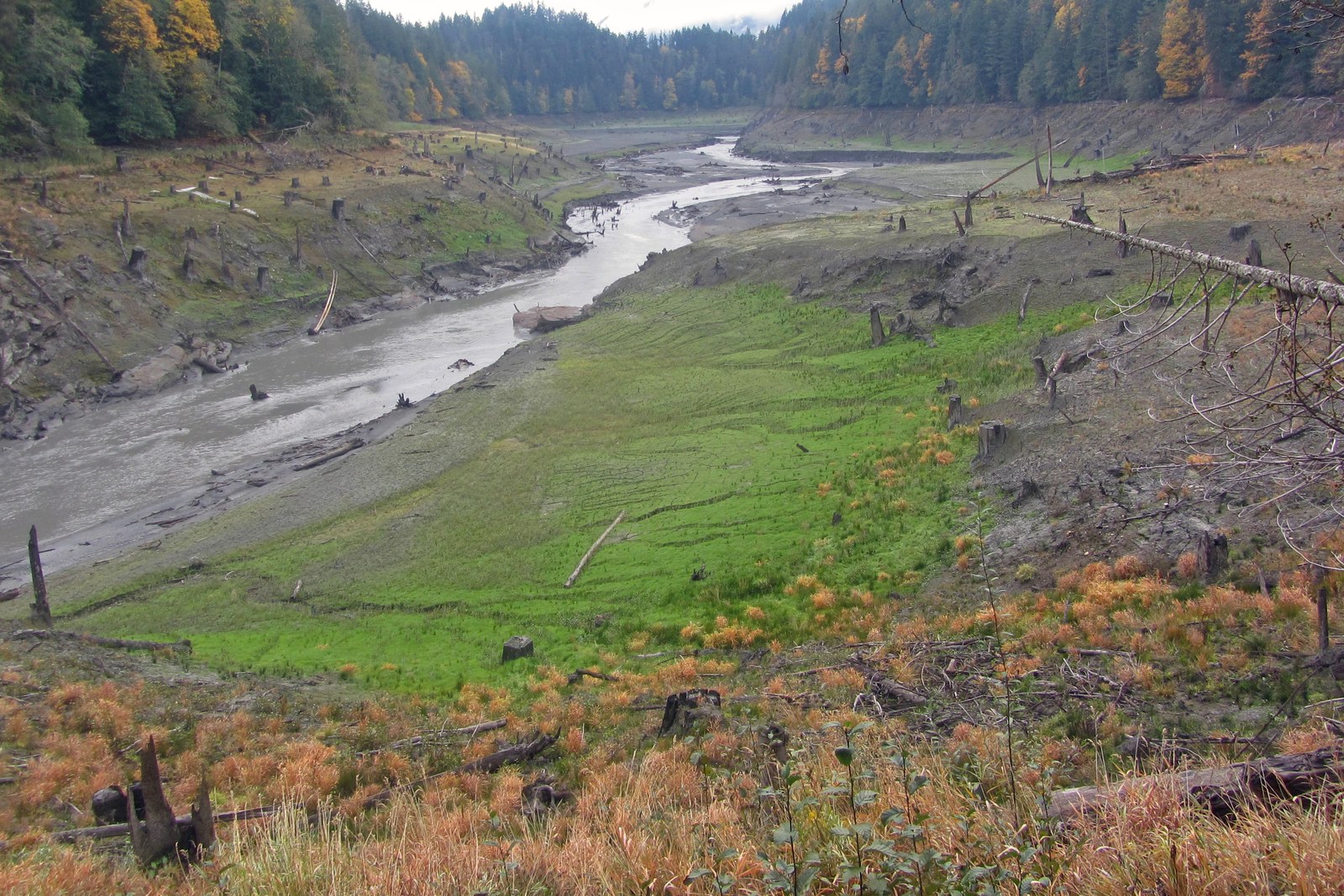
The Elwha River running through the former Lake Aldwell reservoir after the Elwha Dam was removed, Oct. 26, 2012. Photo: Andy Ritchie (cropped and color-corrected by Daniel Case) / Wikimedia Commons, CC BY-SA 2.0 (cropped and resized).
Henry Calloway covers Congress and its Indian affairs committees for Tewatati.