By James Kerrigan, Tewatati
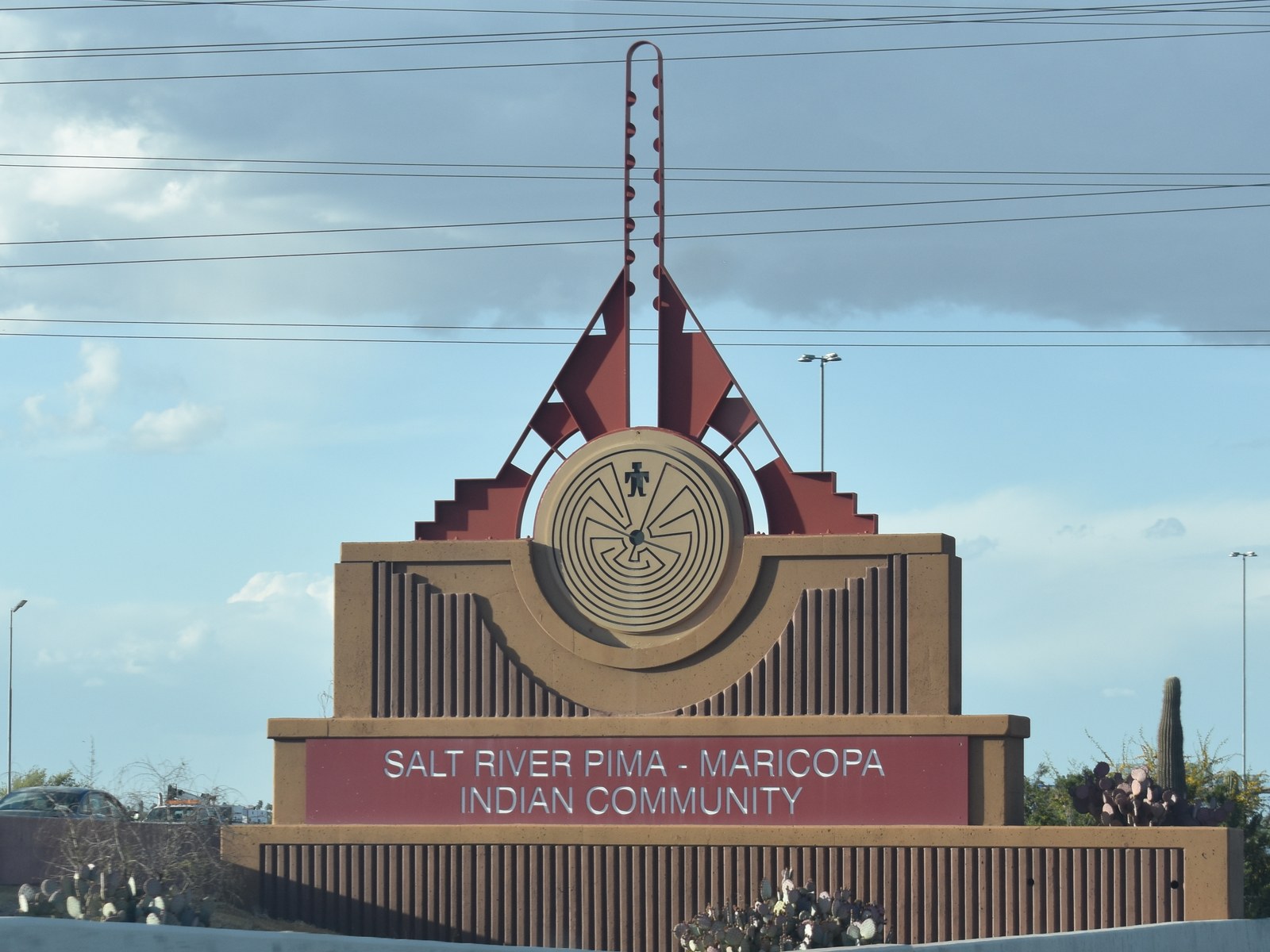
The Salt River Pima-Maricopa Indian Community entrance sign along Loop 101 (2024). Photo: Urban Versis 32 / Wikimedia Commons, CC BY-SA 4.0 (cropped and resized).
Early voting is underway in Arizona, and tribal voter-education groups are warning Native voters about a proposed constitutional amendment. It would require identification for every ballot, including the mail ballots most Arizonans use, but it doesn’t say which IDs will count or how someone voting by mail would show one.
Proposition 144 is a legislative referral its sponsors call the “FAST Election Results Act.” It would write into the Arizona Constitution that “Every voter must show valid government issued proof of identity before casting a ballot in each election, whether voting in person or by any other method, as prescribed by law,” according to an Aug. 19 Arizona Supreme Court decision order.
“Prop 144 does not specify whether IDs issued by sovereign Tribal governments would satisfy the new ‘government-issued identification’ requirement,” Arizona Native Vote warns in its voter guide. “If Tribal IDs are not accepted, some Tribal members may need to obtain state-issued ID, which could require additional documentation, travel, costs, and administrative steps.”
What the measure says, and what it leaves out
Under current law, Arizonans who vote in person show identification, and tribal IDs are already accepted. The state’s Citizens Clean Elections Commission lists a “Tribal enrollment card (or other form of tribal ID)” alongside a driver’s license among the primary forms of ID. It also notes that “Members of federally-recognized tribes are not required to have an address or photo on their tribal identification in order to cast a provisional ballot.” Mail ballots carry no ID requirement. Instead, trained staff check the signature on each envelope against the voter’s signature on file, KOLD News 13 reported.
Prop. 144 would end that distinction. “Over 80% of Arizona voters vote by mail. In Prop. 144, there is no definition of what is considered ‘government-issued identification,’” the Salt River Pima-Maricopa Indian Community says in its election guide. Axios Phoenix reported that nearly 75% of Arizona voters cast mail ballots in 2024, citing the U.S. Election Assistance Commission.
The measure leaves the mail-ballot mechanics to future legislators. At an Oct. 1 debate, Greg Blackie, deputy director of policy at the Arizona Free Enterprise Club, which helped craft the measure, acknowledged that it doesn’t explain how early voters would show ID, Capitol Media Services reported via KAWC. He floated options such as a four-digit code. “Or, who knows? In the future maybe you can go to ‘my.arizona.vote’ and upload a picture of your ID and then your ballot is verified,” he said. He called fears that the measure would end early voting overblown.
Opponents read the measure differently. “Under Prop. 144, voters must put a copy of their ID inside their early ballot envelope every election or have their vote not counted,” the ACLU of Arizona says in its proposition guide. The ACLU opposes the measure and says that narrowing acceptable ID would reduce access “particularly for rural voters, young people, low-income, or other marginalized people.”
The amendment would also allow on-site tabulation on Election Day and bar foreign spending in Arizona elections. Election laws would be judged by whether they are “rationally connected to a legitimate state interest,” a lower standard. The SRPMIC guide warns that this would make “it harder to challenge election laws in the future.” Changes would take effect in 2028, according to Axios and the Arizona Mirror, which reported that Republican legislators referred the measure on a party-line vote in June, bypassing Gov. Katie Hobbs.
An ID settlement tribes fought for
For tribal nations, the question of which IDs count is not new. Arizona adopted its voter ID law in 2004. Patty Ferguson-Bohnee, director of the Indian Legal Clinic at Arizona State University’s law school, told a U.S. House elections subcommittee in 2019 testimony that in the 2006 election, “428 Navajos voted provisional ballots that were never counted because they did not verify their identification.”
One of the voters turned away in 2006 was Agnes Laughter, a Navajo elder who had always voted using her thumbprint, ASU News reported in 2008. “When I was told it was not valid, I went through much sorrow, much heartbreak,” she said then, through an interpreter.
The Navajo Nation, the Hopi Tribe and the Inter Tribal Council of Arizona went to court. In May 2008, the parties signed a joint stipulation that expanded the accepted IDs to include tribal enrollment cards, Certificates of Indian Blood, tribal voter registration cards, home-site leases and grazing permits, and that let a tribal member vote a provisional ballot with a single tribal ID bearing their name. Arizona Native Vote’s guide says a “no” vote on Prop. 144 “Keeps the Tribal ID settlement intact.” Because the amendment says nothing about tribal IDs, it falls to future lawmakers and the courts to decide whether those documents still count.
Mail voting where there is no mailbox
Mail voting was already harder on many reservations. In her 2019 testimony, Ferguson-Bohnee said that “only 18% of reservation voters outside of Maricopa and Pima Counties have physical addresses and receive mail at home.” She said many rely on post office boxes that “may be a 45 minutes to a 2 hour drive away.” Arizona Native Vote’s guide warns that “Tribal members who vote by mail may have to complete additional steps.”
When the Legislature referred the measure, state Sen. Analise Ortiz, a Democrat, said it would cost “senior citizens, rural voters, tribal voters, people with disabilities, people who work multiple jobs and can’t wait in long lines” their access to mail voting, according to the Arizona Mirror.
The campaigns
Tempe City Councilmember Randy Keating chairs the No on 144 campaign. At the Oct. 1 debate he called it “a clever attempt to trick us into surrendering or voting away one of our most fundamental rights.” Of the lower legal standard, he said, “When it is passed the Legislature will have carte blanche.” Blackie countered that federal courts would remain open to challenges.
Arizona voters rejected a similar ID measure, Proposition 309, in 2022 by 1,219,669 votes to 1,201,181, according to the Arizona Legislative Council.
How to vote this year
Nothing changes for the Nov. 3 general election. Under SRPMIC’s guide, Oct. 27 is the last day to mail a ballot back. After that, voters should return ballots in person. Oct. 30 is the last day of early in-person voting, according to the Arizona Mirror’s voter guide. Arizona Native Vote runs a hotline for Native voters at 1-888-777-3831. SRPMIC members can call the community’s election help line at 480-362-5520.
The ACLU of Arizona said it could not respond before publication. Alexander Gonzalez, a communications strategist for the group, offered an interview with its policy director, Darrell Hill, after the deadline and pointed Tewatati to Arizona Native Vote and the ASU Indian Legal Clinic. Judy Ferreira, executive director of the Arizona Indian Gaming Association, referred questions to the Inter Tribal Council of Arizona, one of the parties to the 2008 settlement, which she said works on voter protection initiatives.
Ferguson-Bohnee; the Salt River Pima-Maricopa Indian Community’s voter information office; the Arizona Free Enterprise Club; Arizona Native Vote; and Keating did not respond to requests for comment by publication time.
James Kerrigan covers politics for Tewatati.