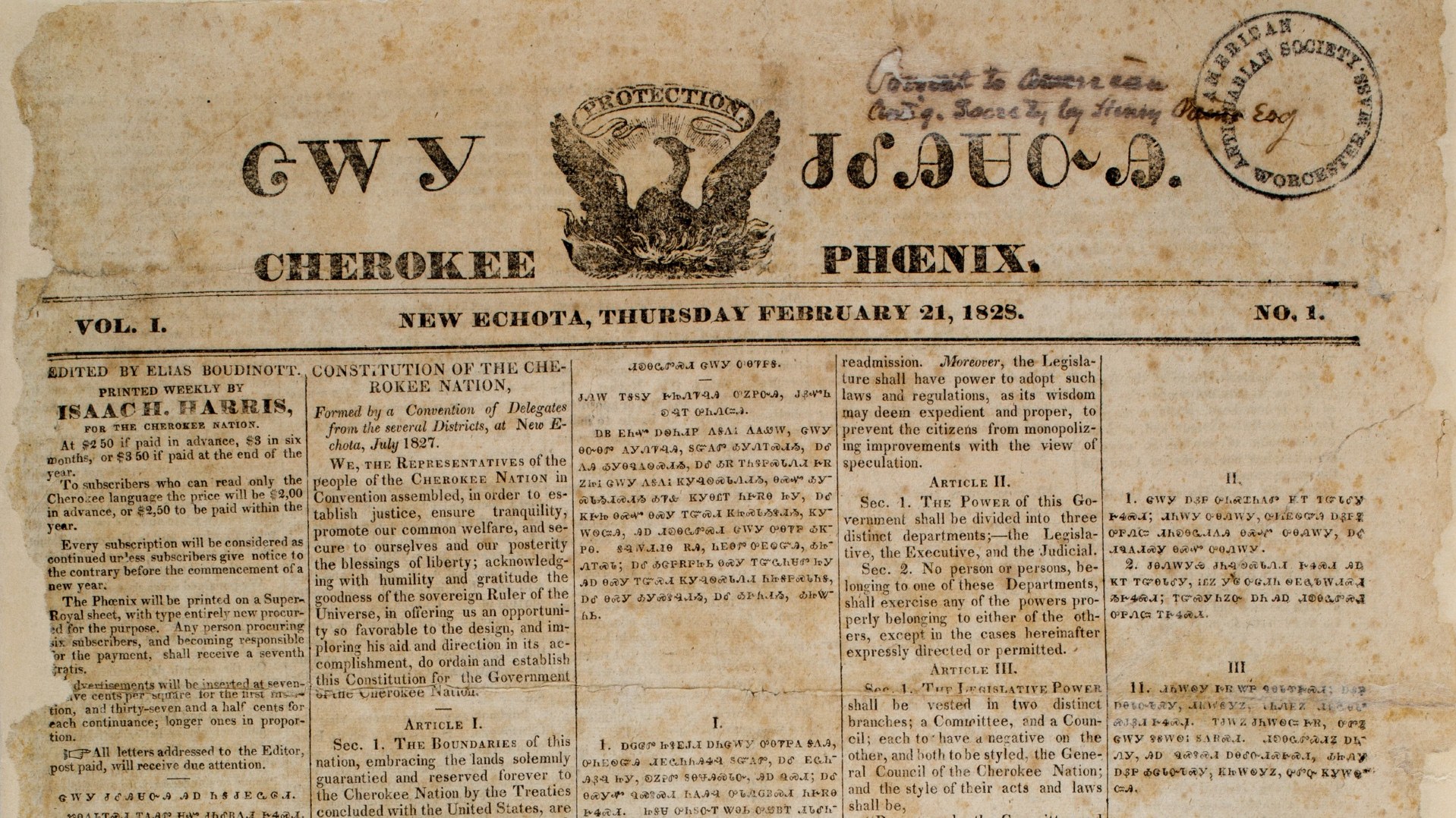
The first issue of the Cherokee Phoenix, published by the Cherokee Nation at New Echota on Feb. 21, 1828, in English and Cherokee syllabary. Image: Wikimedia Commons (American Antiquarian Society copy), public domain; cropped.
This is an editorial by the Tewatati Editorial Board. It represents the institutional view of the publication. News coverage on this site is reported and edited separately.
Every day, decisions are made in Washington, Ottawa, Mexico City and dozens of state and provincial capitals that shape the lives of Indigenous peoples. Funding is cut or restored. Pipelines are designated. Child welfare programs change hands. Laws are drafted in the name of consultation. Too often, these stories are told from the outside: as budget lines, as regulatory disputes, as obstacles to someone else’s project.
Tewatati exists to tell them from a different starting point.
Nations, not interest groups
We begin with a fact that North American law itself recognizes, even when its governments fail to honor it: Indigenous nations are political entities with inherent sovereignty. In the United States, that status predates the Constitution and is reflected in hundreds of treaties. In Canada, Aboriginal and treaty rights are affirmed in Section 35 of the Constitution Act, 1982. In Mexico, a 2024 constitutional reform recognized Indigenous and Afro-Mexican peoples as subjects of public law.
That starting point shapes how we report. When a federal agency cancels a grant to a tribal government, we ask not only what it costs but what obligation it touches. When a government promises consultation, we ask who was consulted and whether their answer could change the outcome. When a nation builds a court system, a language school or a business enterprise, we treat it as what it is: an exercise of self-government.
What we believe
We say plainly that this publication supports Indigenous sovereignty, self-determination and nation building. We believe Indigenous peoples have the right to govern their lands, raise their children within their own cultures, control their economies and decide their political futures. We believe treaties are binding law, not historical artifacts. We believe the long movement for political liberation, from the courts to the ballot box to the land itself, deserves serious and sustained coverage.
That perspective guides our choice of stories and our editorials. It does not license us to bend facts.
What we promise readers
Our commitments are simple:
- We will not invent. Every fact, figure and quotation we publish will be sourced, and we will link to our sources whenever we can.
- We will be fair. When governments, companies or other parties disagree with Indigenous nations, we will report their positions accurately and in their own words.
- We will label our work. News, analysis and opinion will be clearly marked.
- We will hold Indigenous institutions to the same standard. Sovereignty includes accountability. When tribal governments face serious allegations, as Red Lake Nation’s child welfare program does now, we will report them carefully, include the nation’s response and keep the focus on the children and families affected.
- We will correct our mistakes, promptly and visibly.
Across borders, and in the cities
Indigenous nations did not draw the lines between the United States, Canada and Mexico, and many span them. Our coverage will cross those borders, too: tribal nations in the U.S., First Nations, Inuit and Métis in Canada, and Indigenous peoples in Mexico. And we will not forget that most Native people in the United States live in cities, often far from home communities, served by urban Indian organizations that rarely make headlines.
An invitation
We want to hear from you: tribal citizens, leaders, elders and young people, lawyers, artists, organizers and officials. If you know a story we should be telling, submit a tip. If we get something wrong, tell us.
The name of this publication carries a responsibility. We intend to earn it.
— The Tewatati Editorial Board