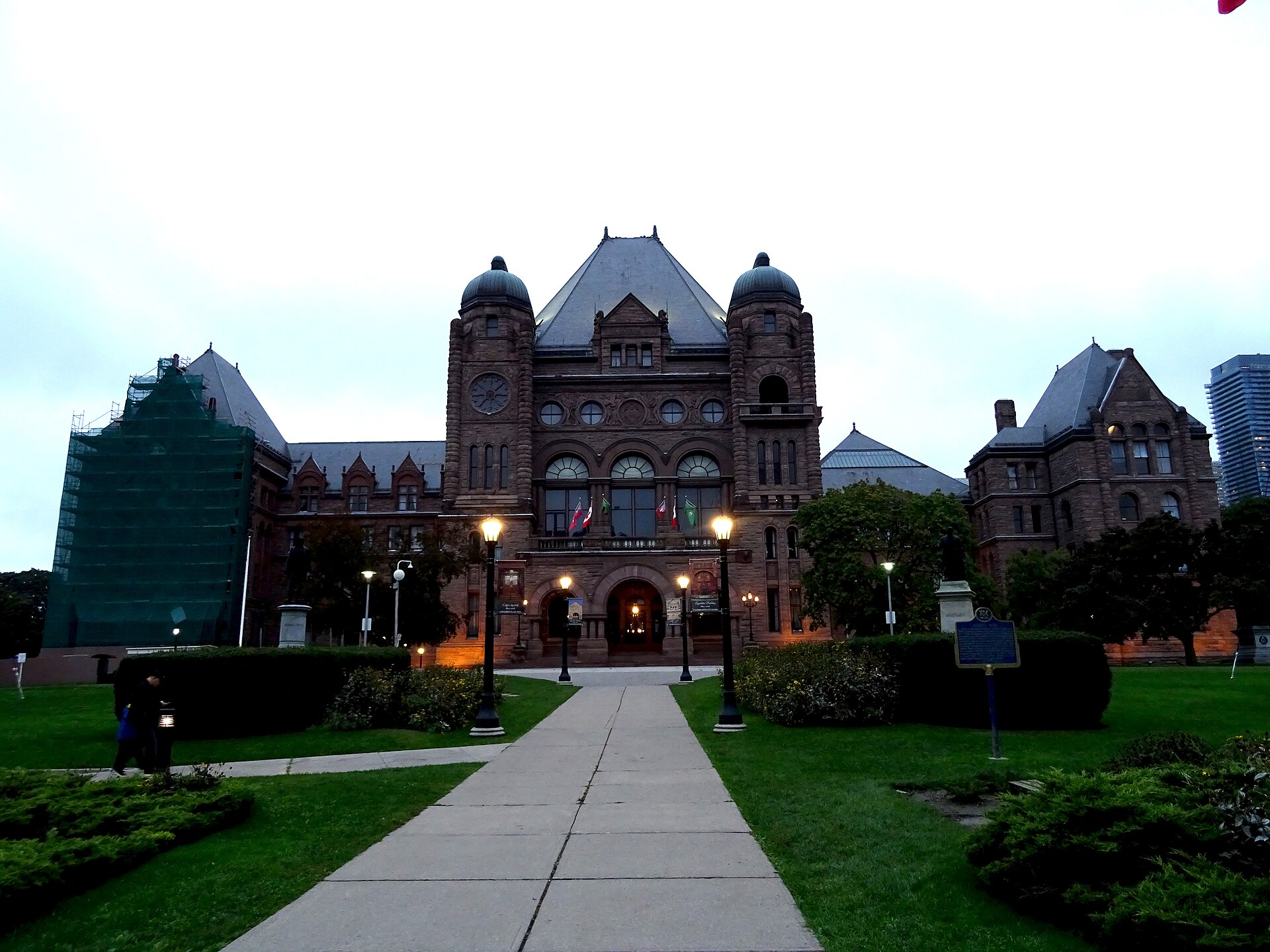
The Legislative Assembly of Ontario at Queen’s Park, Toronto. Photo: Spudgun67 / Wikimedia Commons, CC BY-SA 4.0.
EXPLAINER: This article provides background and context on an ongoing legal case.
Fourteen First Nations are challenging two laws designed to speed up major development in Canada: the federal Bill C-5, passed by Parliament in June 2025, and Ontario’s Bill 5. Their case, in the Ontario Superior Court of Justice, could help define what the Crown owes Indigenous peoples when it writes laws, not just when it approves projects.
What the laws do
Bill C-5 allows the federal cabinet to quickly grant approvals for large projects deemed to be in the national interest, such as mines, ports and pipelines, by sidestepping existing laws, CBC News reported. Its Building Canada Act is the law under which Ottawa designated the Pacific Link oil pipeline, a decision Cold Lake First Nations is separately challenging in Federal Court.
Ontario’s Bill 5 allows the provincial cabinet to suspend provincial and municipal laws through the creation of “special economic zones.”
Who is challenging them
Nine First Nations originally filed the application. In early 2026, five more joined: Walpole Island First Nation (Bkejwanong), Kashechewan First Nation, Mississaugas of the Credit First Nation, Wapekeka First Nation and Wunnumin Lake First Nation.
For some, the concerns are specific. “Bill 5’s removal of the requirement for an environmental assessment of the proposed Dresden Landfill is a direct threat to my community’s wellbeing and our ability to continue to practise our way of life,” Bkejwanong Chief Leela Thomas said in a January news release. A spokesperson for YORK1 Environmental Waste Solutions, which owns the Dresden site, told CBC the company holds existing environmental compliance approvals from Ontario’s environment ministry.
Chief Sheri Taylor of Ginoogaming First Nation, one of the original nine, said her nation had no choice. “We need to be part of that conversation well ahead of time before they even receive a permit,” she said.
The arguments
Lead counsel Kate Kempton of Woodward and Company Lawyers told CBC the laws set reconciliation back 40 years.
“Both of these laws give the respective governments absolute power … to make huge decisions about massive developments on lands without applying and abiding by any other laws at that level of government,” Kempton said.
The challenge rests on three pillars:
- Section 7 of the Charter of Rights and Freedoms, the right to life, liberty and security of the person. Kempton argues that laws enabling sweeping environmental damage, including climate change, cause severe mental, cultural and social distress.
- Section 15 of the Charter, equality. The nations argue the laws will disproportionately harm First Nations.
- Section 35 of the Constitution Act, 1982, which affirms Aboriginal and treaty rights.
The honour of the Crown
The Section 35 argument is the most novel. In Mikisew Cree First Nation v. Canada (2018), the Supreme Court of Canada held that the Crown does not have a duty to consult Indigenous peoples when preparing legislation, but that the honour of the Crown still applies to the legislative process.
What that honour requires has never been decided by a court, Kempton said. The nations’ answer: “It means that you can’t set reconciliation back. It means that you can’t make it harder to effect reconciliation, as both of these laws do.”
If a court accepted that theory, it would create a meaningful limit on governments’ power to legislate around Indigenous rights, even without a formal duty to consult.
The governments’ positions
Ontario’s Ministry of Indigenous Affairs and First Nations Economic Reconciliation declined to comment because the matter is before the courts.
The federal Privy Council Office said Canada needs to boost its economy by diversifying trade, building infrastructure and responsibly developing energy and natural resources “at speeds not seen in generations.”
“The prime minister has emphasized that national interest projects can only be done in full consultation and co-operation with Indigenous Peoples, to strengthen Indigenous ownership and partnerships, and support generational economic opportunities in their communities,” the statement said.
What’s next
No ruling has been reported. The case sits alongside the Cold Lake challenge and other disputes over whether Canada’s push to build faster can be squared with its constitutional obligations, and with its commitment to the United Nations Declaration on the Rights of Indigenous Peoples.
Source: CBC News.