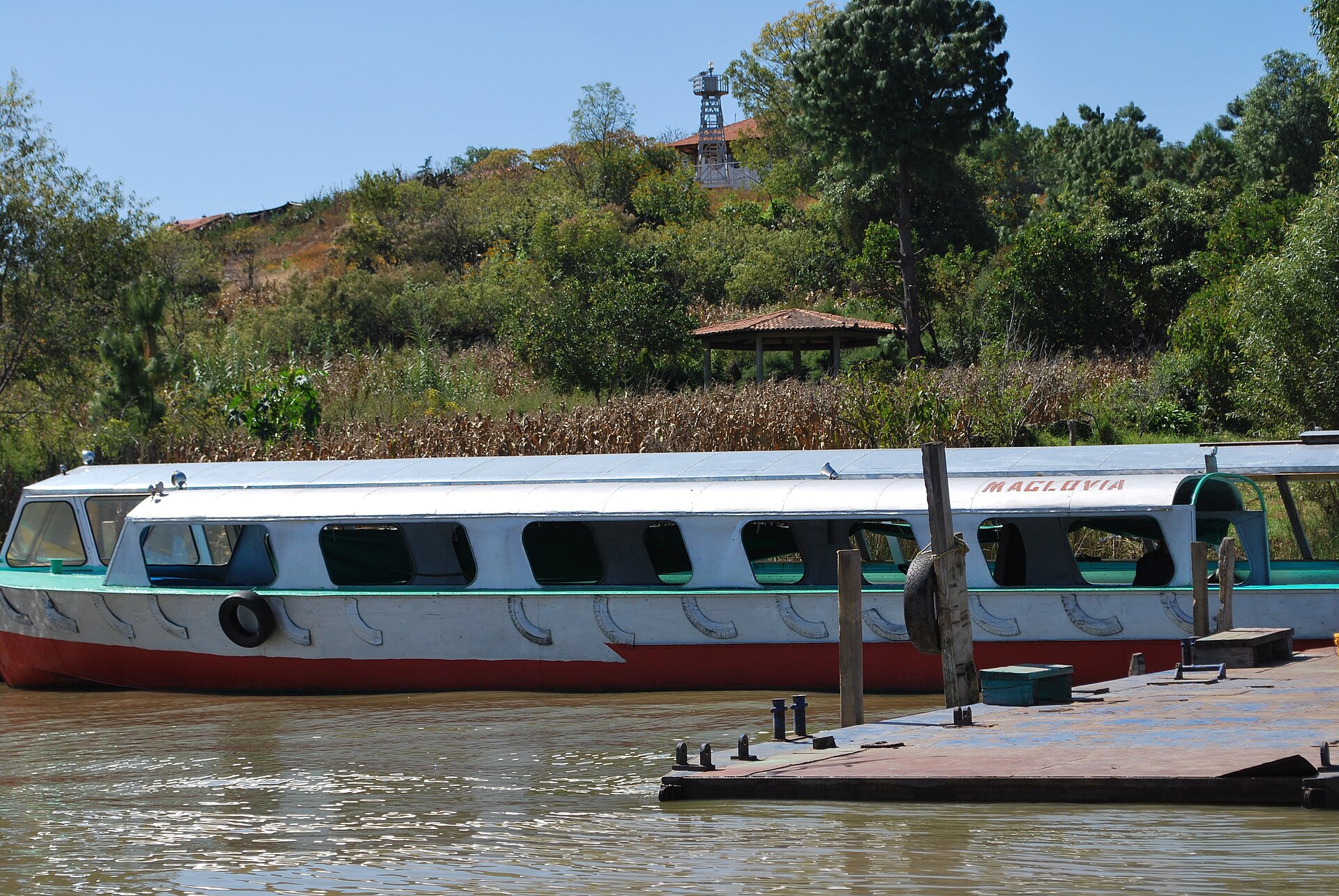
Boats at the dock of La Pacanda Island in Lake Pátzcuaro, Michoacán (2009). Photo: Thelmadatter / Wikimedia Commons, CC BY-SA 3.0.
Three Purépecha communities in the Mexican state of Michoacán have voted in the past two weeks to govern themselves under their own customs and to take direct control of the share of municipal funds that corresponds to their population, adding momentum to one of the most concrete exercises of Indigenous self-determination in Mexico.
On Sunday, Oct. 18, the community of San Andrés Tziróndaro, in the municipality of Quiroga on the shore of Lake Pátzcuaro, approved self-government 808 votes to none in a consultation held in its main plaza, Quadratín Michoacán reported, citing the Michoacán Electoral Institute (IEM), which organized the vote with the community. A week earlier, on Oct. 11, residents of Huecorio, in the municipality of Pátzcuaro, voted 232 to 4 for self-government and direct administration of their budget, according to the IEM. And in Acachuén, in the municipality of Chilchota, a show-of-hands vote conducted in Spanish and P’urhépecha produced 602 votes in favor and 81 against, Respuesta Michoacán reported Oct. 12.
Self-government will let Tziróndaro “access the direct budget that corresponds to it according to its number of inhabitants,” which the municipal government must transfer periodically, La Jornada reported. (Quotations from Spanish-language sources in this article are Tewatati translations.)
How the votes work
Each vote followed the same procedure. IEM staff registered participants with the help of community members, who verified that those attending belonged to the community. Electoral councilors from the IEM’s Commission for Attention to Indigenous Peoples and Communities, chaired by Councilor Carol Berenice Arellano Rangel, then explained the scope of self-government and the administrative, financial and legal responsibilities of managing public money directly, and took questions. Only then did residents decide, by the mechanism the community’s assembly had approved.
The result is not symbolic. Under what Michoacán calls presupuesto directo, a community that completes the process receives its proportional share of municipal resources and spends it through its own communal government, rather than waiting for a municipal council in a distant town hall to decide what it will get. In Acachuén, the IEM noted that the transition takes effect once the required fiscal procedures are completed.
Michoacán Gov. Alfredo Ramírez Bedolla said after the Huecorio vote that the step “consolidates the exercise of participatory democracy and unrestricted respect for the rights of the original peoples,” and put the number of Indigenous communities administering their budgets directly at 55, La Jornada reported. Pavel Guzmán, coordinator of the Supreme Indigenous Council of Michoacán (CSIM), which has accompanied these processes for 12 years, told La Jornada after the Tziróndaro vote that 57 communities have achieved autonomy and that about 50 more small Indigenous towns are in the process.
“It is worth underlining that nearly all of those that have achieved their autonomy and direct budget have been able to carry out important public works in their places of origin,” Guzmán said.
He added that self-governing communities can also formalize their community security forces, known as rondas comunitarias, and adopt development plans approved by the community’s general assembly, “which is the highest authority.”
The fight over the money
The votes do not end the struggle. Guzmán told La Jornada that some municipal authorities have refused to hand over the direct budget even after the IEM and the state electoral tribunal have ruled. In its Oct. 12 report on Huecorio, La Jornada noted that municipal authorities in Quiroga, Erongarícuaro, Los Reyes and Salvador Escalante, among others, had obstructed the installation of self-governments before ultimately yielding “because it is a constitutional mandate.”
The sharpest current case is La Pacanda, an island community of about 600 people in Lake Pátzcuaro. La Pacanda voted for self-government in an IEM consultation on June 27. When the municipal government of Tzintzuntzan did not convene the council session needed to transfer the money, the island’s Communal Government Council sued on Aug. 27, MiMorelia reported. The community estimates it would receive about 1.6 million pesos a year.
Asked what explanation the municipality had given, Armando González Alejo, secretary of La Pacanda’s council, told MiMorelia: “Well, practically that the mayor is never there.” The decision to manage its own resources, he said, is not a request for extraordinary help but the exercise of a right defined through the official procedure.
On Oct. 9, the Michoacán State Electoral Tribunal ruled in case TEEM-JDC-088/2026 and ordered Tzintzuntzan’s council to meet within six business days and authorize the state finance ministry to transfer the funds, according to a CSIM statement. The council accused Mayor Patricio García Alva and Síndica Tomasa Sandoval Ceras of refusing for three months to call the session as “a form of reprisal” against the community. “History and the laws proved them right,” the statement said. “Self-government is an unstoppable reality.”
Yet nine days later, Guzmán told La Jornada that the Tzintzuntzan government was still refusing to hold the council session. Tewatati did not find a public response from the municipality in published reports.
A movement with deep roots
The current wave builds on a precedent set in 2011, when Mexico’s federal electoral tribunal ruled in case SUP-JDC-9167/2011 that “the members of the Indigenous community of Cherán have the right to request the election of their own authorities, following their own norms, procedures and traditional practices,” as scholars of the Cherán process have documented. Cherán, a Purépecha town in the Meseta region, has governed itself through a communal council since.
The communities’ advance comes as Indigenous peoples across Mexico contest how the federal government is writing a national law on their rights. In a statement reported Oct. 12, Purépecha, Matlatzinca, Nahua and Afro-Mexican communities affiliated with the CSIM said they had filed a collective amparo against the National Institute of Indigenous Peoples’ consultation on the proposed General Law on the Rights of Indigenous and Afro-Mexican Peoples, calling it “simulated,” La Jornada reported. They said the process left out 109 Michoacán communities that are not in the institute’s catalog. The same day, President Claudia Sheinbaum said the consultation will be extended, as Tewatati reported.
The contrast is instructive. In Mexico City, the question is still how a federal statute will describe Indigenous autonomy. On the shores of Lake Pátzcuaro, communities are exercising it now, one assembly and one budget transfer at a time, and testing whether municipal governments will honor what their own state’s institutions have recognized.