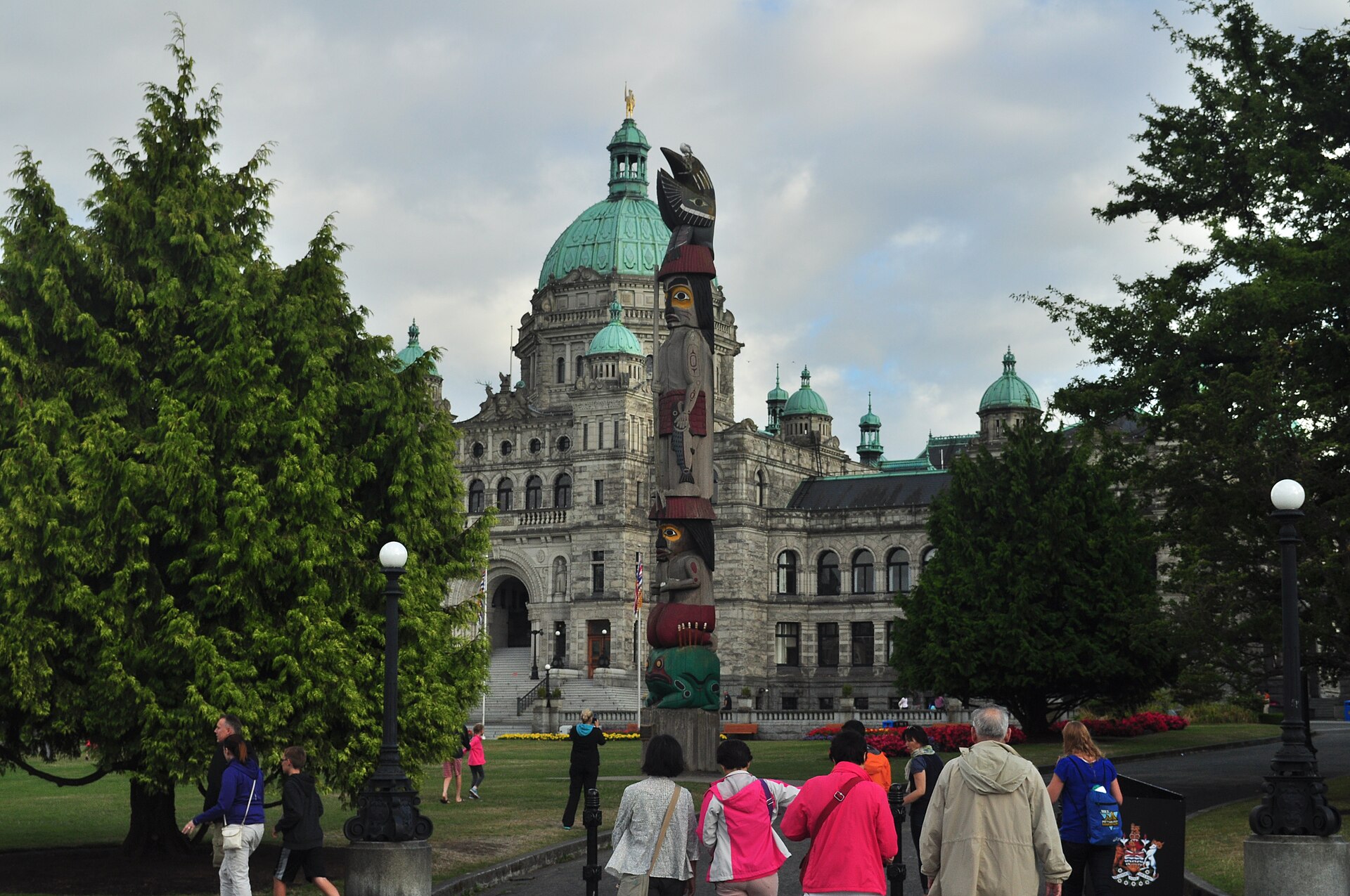
A totem pole stands before the British Columbia Parliament Buildings in Victoria (2015). Photo: Joe Mabel / Wikimedia Commons, CC BY-SA 3.0.
When British Columbians finish voting on Saturday, Oct. 24, they will have decided more than who governs from Victoria. The province’s snap election has become a referendum of sorts on two things First Nations regard as settled: land the province has already agreed to return, and the law that commits B.C. to the United Nations Declaration on the Rights of Indigenous Peoples.
The race is close. An Angus Reid Institute survey conducted Oct. 15 to 19 put the B.C. Conservatives at 46 per cent and the NDP at 43 per cent among decided and leaning voters, a statistical tie. Asked about the Declaration on the Rights of Indigenous Peoples Act (DRIPA), 44 per cent favoured the Conservative pledge to repeal it; 24 per cent would maintain it and 11 per cent would expand it.
400 parcels, and who pays
The land question surfaced on Oct. 15, when columnist Rob Shaw reported in Northern Beat on confidential provincial briefing documents dated Sept. 10. “Presently, there are approximately 400 parcels committed for transfer through Treaty and reconciliation agreements,” one document reads.
The documents describe obligations the Crown has already made, and an obstacle to completing them: under the Forest Act, the province must compensate forest companies whose harvesting rights are removed when land is transferred for “First Nations purposes.” Citing “ongoing fiscal constraints” (the province is running a $13-billion deficit, Shaw noted), the briefing calls those provisions “substantial barriers to completing land returns” and states an aim to “support timely and predictable First Nations land returns by addressing financial considerations that may otherwise create delays.”
The proposal would let the province remove harvesting rights for First Nations land transfers without compensation, as it already can for roads, pipelines and parks, until a tenure holder’s cumulative reductions exceed five per cent of its allowable annual cut. Shaw reported that cabinet approved the approach in July. The NDP campaign said cabinet approved only engagement with stakeholders, that the work paused when the election was called, and that only about half the parcels have potential forestry impacts, Global News reported.
NDP Leader David Eby, still premier during the campaign, defended the plan as a matter of cost. The transfers reflect existing treaties and agreements, “some of which are historic with First Nations,” he said, and the legislation “provides a little bit of relief in terms of cost for taxpayers,” The Canadian Press reported.
Kim Haakstad, head of the Council of Forest Industries, said companies should not absorb the cost. “When we’re making reconciliation agreements with Nations, the budget should include the compensation for people that have lost opportunity on the land base,” she told the Vancouver Sun. The Conservatives called the plan “more secret dealings.” Their 2024 platform, The Canadian Press noted, committed the party to “the strategic and collaborative return of land to First Nations, enabling bands to forge their own economic future.”
Land that is already owed
Lost in the argument over compensation is how long some nations have waited. The NDP told Northern Beat that some parcels may already have been disclosed through long-negotiated agreements, including with the Lake Babine Nation, the K’ómoks First Nation and the Cheslatta Carrier Nation. When Lake Babine signed a 2023 land transfer agreement carrying out a 2020 commitment to return 20,000 hectares, Chief Murphy Abraham said, “This is just the beginning. Our ancestors fought hard to protect our territory, and the land transfer agreement is the first step in bringing these lands back to Lake Babine control and decision-making,” according to the province.
The Cheslatta, whose 2023 land transfer agreement is titled “Footprints Back on Our Land,” signed a 2019 settlement with the province that provides redress for ancestors who “were forcibly evicted from their homes in 1952 to make way for the Nechako Reservoir,” Chief Corrina Leween wrote.
DRIPA on the ballot
The larger fight is over DRIPA, which the legislature passed unanimously in 2019. In the Oct. 14 leaders’ debate, interim Conservative Leader Lorne Doerkson said, “The reality is that DRIPA has to be repealed,” while pledging partnerships with First Nations, CBC News reported. Eby, who proposed suspending parts of the law this spring before shelving the changes, did not reaffirm a commitment to amend it, saying “there is only one path forward and that is in partnership with the Indigenous people of this province.” Green Leader Emily Lowan said DRIPA “has no bearing on private property” and that her party would keep implementing it.
First Nations leaders have answered both main parties. “The BC Conservatives’ collapse is the direct consequence of selling fear, misinformation, and a culture war narrative to a public who refused to scapegoat their neighbours,” B.C. Assembly of First Nations Regional Chief Terry Teegee said when the campaign began, adding that the NDP “have been caught courting these same arguments,” according to the BCAFN. At the BCAFN’s annual meeting last week, Eby and Lowan addressed the chiefs; the organization said it received no response from Doerkson or the Conservatives.
Union of B.C. Indian Chiefs President Grand Chief Stewart Phillip wrote on Oct. 13 that the real threat “is a political system that repeatedly forces First Nations to prove and defend our rights in court instead of providing a durable, co-developed framework for governments to work together,” in an essay for the Canadian Centre for Policy Alternatives. Phillip still backs Eby as premier while endorsing Lowan in her riding, and First Nations Summit political executive member Hugh Braker said he was “really torn” about voting NDP, the Vancouver Sun reported.
Repeal would not erase Aboriginal title and rights, which are protected by Section 35 of the Constitution and continue to be tested in court, including in the Cowichan title case and the Gitxaała mineral-claims case, both under appeal. What it would remove is the statutory framework, including consent-based decision-making agreements, that First Nations leaders say has begun to replace litigation with negotiation.
Asked about the land returns proposal, Ellena Neel, communications manager for the Union of B.C. Indian Chiefs, told Tewatati in an email: “We have not been involved in this specific work you have cited.” She suggested contacting the BC First Nations Forestry Council, which Tewatati had also asked for comment.
The B.C. Assembly of First Nations, the BC First Nations Forestry Council, the BC Treaty Commission, the Council of Forest Industries, the BC NDP and the Conservative Party of British Columbia did not respond to a request for comment by publication time.