By Leah Brandt, Tewatati
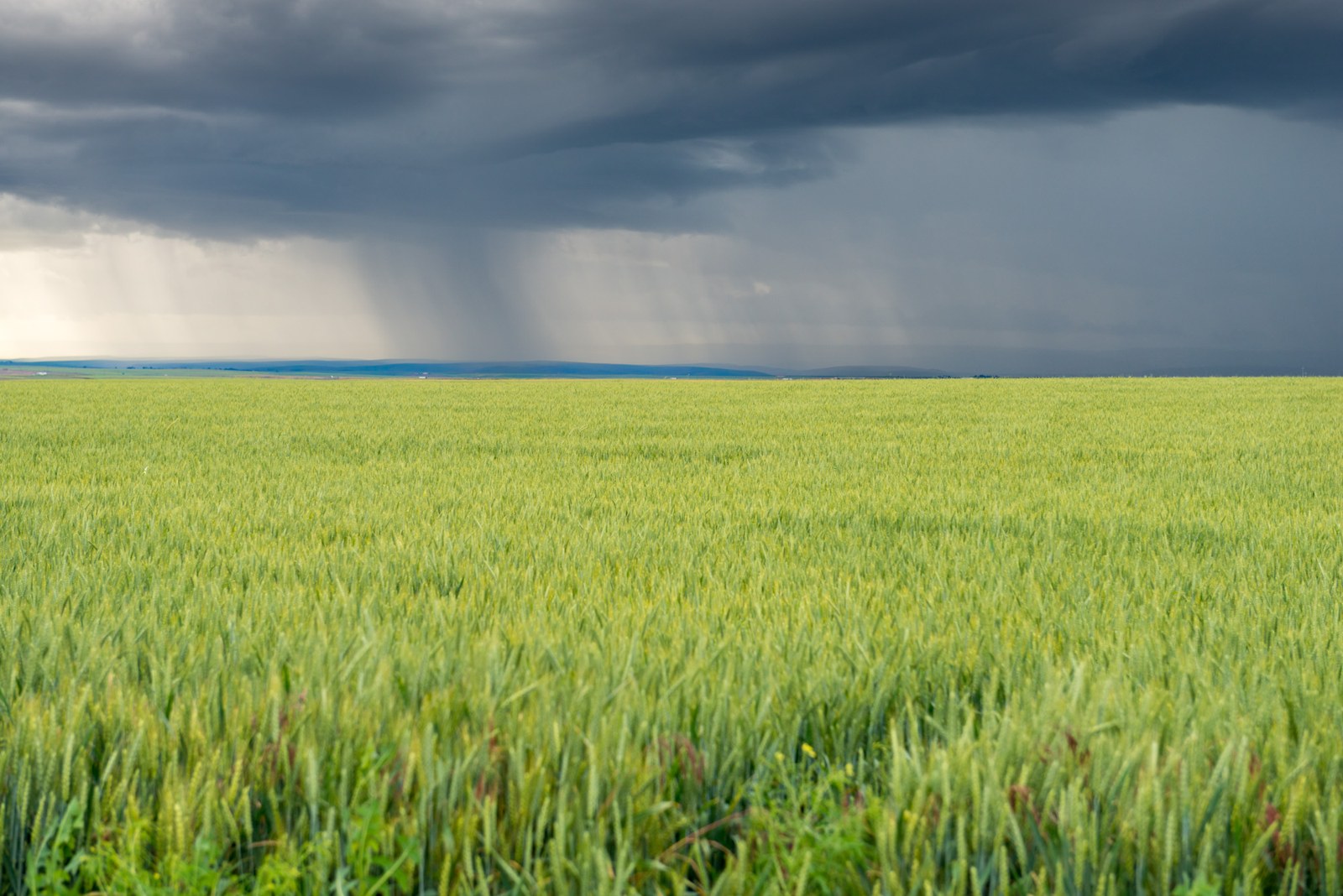
A field along the Umatilla-Mission Highway (Oregon Route 331) in Umatilla County, Ore. (2017). Photo: Gary Halvorson, Oregon State Archives / Wikimedia Commons, CC BY 4.0 (resized).
For generations, the wheat grown on the rolling hills of Umatilla County has left northeastern Oregon the way commodity grain usually does: unprocessed, at a price set on a global market. A new flour mill on the Umatilla Indian Reservation is a bet by the Confederated Tribes of the Umatilla Indian Reservation that more of that value can stay at home, and that the tribes can own a share of it.
Cairnspring Mills celebrated the opening of its Blue Mountain Mill on Oct. 15 at Coyote Business Park, a commercial and industrial development of more than 170 acres that the CTUIR owns at the base of the Blue Mountains near Pendleton. The tribes leased the site to the company for 50 years and invested $5 million in Cairnspring, the CTUIR’s first equity stake in a private company, according to the company’s Oct. 20 announcement. The mill is expected to begin commercial production in November.
“Wheat is king in Umatilla County, but for generations most of its value has left with the grain,” Bill Tovey, director of the CTUIR Department of Economic and Community Development, said in the announcement. “This mill changes that. It brings value-added agriculture home, creates local jobs and gives the Tribes ownership in a growing company that can benefit our people and our neighbors for decades to come.”
The project is the tribes’ largest public-private partnership investment, the East Oregonian reported. It reflects a strategy tribal nations have pursued across Indian Country: using land, capital and governmental standing not only to host outside enterprises but to hold equity in them, so that the returns from a reservation economy accrue to the nation that governs it.
A mill in the middle of wheat country
The 27,000-square-foot stone mill is built for high-volume hard red wheat. At full speed it will raise Cairnspring’s annual milling capacity from about 8 million pounds to more than 115 million pounds, source wheat from about 60,000 acres, generate more than $22 million a year for farmers and create more than 22 local living-wage jobs, the company said. Its original mill in Burlington, Wash., built a decade ago with the Port of Skagit, will focus on specialty flours.
“That 115 million pounds a year will take us 24/7 – that’s still what one big mill can make in about two and a half weeks. So, we’re still a craft mill,” Kevin Morse, Cairnspring’s co-founder and CEO, told Elkhorn Media Group.
The location answers a regional need. A fire in August 2022 destroyed most of Pendleton’s historic downtown flour mill. “We had been hearing from farmers that they had lost some markets and business because of that,” Morse told the East Oregonian. “So we’re in the perfect place because we’re in the middle of a massive supply chain.”
Oregon’s wheat economy is heavily exposed to export markets. More than 90% of the wheat grown in the state is exported, mostly to Asian countries such as the Philippines, South Korea and Japan, and farmers have faced disruptive U.S. trade policies and rising diesel and fertilizer costs, OPB reported. Cairnspring says it buys grain directly from farmers at prices above the commodity market.
What the tribes are building
The CTUIR, made up of the Cayuse, Walla Walla and Umatilla Tribes, was formed under the Treaty of 1855 and adopted a constitutional government in 1949 “to protect, preserve, and enhance the reserved treaty rights guaranteed under federal law,” according to the tribal description included in Cairnspring’s announcement, which puts enrollment at more than 3,100 members, nearly half living on or near the reservation. The tribes’ economic development department describes its mission as “creating jobs, increasing revenues, and contributing to a diversified and developed economic base.”
The tribes are also wheat growers. The CTUIR’s farm manages about 5,000 acres of wheat a year, and Morse said Cairnspring is working alongside it as well as with 12 farmers in Umatilla County and 45 across the region, Elkhorn Media Group reported.
“We literally geographically are in the heart of wheat country in this area and so the tribe has long wanted to make its tribal farm operation a bigger part of the ag community here,” Susan Bower, the CTUIR’s business development manager, told OPB. “To have a partner, a subject matter expert come forward that really aligned well with the tribe — it was the perfect union.”
Cairnspring says it has worked with the CTUIR’s Workforce Development program and Tribal Employment Rights Office to create training and educational opportunities for tribal members. Neither the company’s announcement nor published coverage has disclosed the size of the tribes’ ownership share, how many of the new jobs will go to tribal members or how returns on the investment will be used.
Native capital in the deal
The financing drew on what Cairnspring called “a first-of-its-kind coalition” that includes the investment firm Steward, Native American Bank, Mission Driven Finance, eight Native community development financial institutions, the U.S. Department of Agriculture, the state of Oregon and community investors, along with New Markets Tax Credits and a substantial investment through the federal EB-5 program. The company did not name the eight Native lenders.
Steward designed the capital stack and helped select the site. Its founder and CEO, Dan Miller, said the firm backed the partnership with the CTUIR “so that Blue Mountain Mill could be built on tribal land.”
Who can sell to the mill
The mill’s premium is not open to every grower. Cairnspring prohibits the farmers it contracts with from using biosolids, neonicotinoids and desiccants, including glyphosate, the East Oregonian reported. Growers in its network have enrolled more than 44,000 acres in A Greener World’s regenerative certification, the company says.
“What we’re trying to do is build that new market that incentivizes the farmer — and frankly gives them the resources — to even think about changing practices,” Morse said at the opening.
How many conventional growers in the region will make that shift remains an open question, but the state’s wheat growers’ league reports strong interest. Amanda Hoey, chief executive of both the Oregon Wheat Growers League and the Oregon Wheat Commission, told Tewatati in an email that after the 2022 Pendleton fire, “the capacity for local flour milling was significantly diminished,” and that several growers in Umatilla County and surrounding areas had arrangements to deliver wheat specifically to that mill.
“There is significant interest in restoration of opportunities for growing wheat to meet the needs of the new Cairnsprings facility. We are looking forward not just to their opening, but future expansion,” Hoey wrote on behalf of the league. “It is a unique partnership that benefits the community, wheat producers, and the mill and can showcase the capabilities of premium Oregon wheat.”
The Native American Agriculture Fund declined to comment. A representative for Cairnspring Mills acknowledged Tewatati’s questions and said responses were being prepared, but none had been received by publication time. The Confederated Tribes of the Umatilla Indian Reservation and Native American Bank did not respond to requests for comment by publication time.
Leah Brandt covers economic development and trade for Tewatati.