By Claire Bastien, Tewatati
When the House of Commons returns on Nov. 16, Budget 2026 will still be awaiting its vote. Finance Canada’s budget-day release says the plan advances reconciliation with Indigenous Peoples “through more than $50 billion in investments.”
The budget motion asks MPs to “approve in general the budgetary policy of the government.” House rules give it four days of debate before a vote that is a matter of confidence, The Hub reported, and with a Liberal majority the outcome is not in doubt. Debate opened Nov. 5 and resumed Nov. 6, according to the House record, before a week-long break shown on the House sitting calendar. No recorded vote on the budget had taken place as of Nov. 13, according to the House votes record, and Tewatati could not confirm a date for the final vote.
What the chapter promises
The budget’s Indigenous section, section 4.3, is built around “$32 billion over 10 years for First Nations housing and infrastructure.” The largest piece is $18.5 billion over 10 years, starting in 2027-28, for a new First Nations On-Reserve Infrastructure Program covering assets “from roads and bridges to schools and health facilities.” It would extend water and wastewater investments “for six years beyond funding announced in June 2026.”
Housing would get $11 billion over 10 years, which the budget says would help maintain 119,000 existing units and build more than 6,900 new homes, plus $1.7 billion over five years for shovel-ready projects. Another $657.5 million would fund three financing pilots, including a $500 million Monetisation Pilot run through the First Nations Financial Authority.
Beyond housing, the chapter proposes $6 billion over six years for Jordan’s Principle and $5.8 billion over five years for on-reserve elementary and secondary education. It adds $2.9 billion over three years for the Non-Insured Health Benefits Program and up to $633.7 million over four years, plus $250.9 million ongoing, for First Nations and Inuit policing. Pirutsiagutiit, the Inuit-led successor to the Inuit Child First Initiative, would get $575 million over five years.

New money or renewal?
The budget’s cost table for section 4.3 books $26.6 billion over the five years from 2026-27 to 2030-31, the figure CBC News reported as the only detailed spending plan behind the 10-year pledge. That total includes $4.6 billion for water infrastructure that a footnote says was “announced on June 16, 2026,” and policing money announced Oct. 26. The table line for the new housing and infrastructure measures totals $7.9 billion through 2030-31.
Several items are renewals in the budget’s own words, including Pirutsiagutiit funding to “renew the Inuit Child First Initiative” and $806.7 million to “renew funding” for the federal First Nations, Inuit and Métis child welfare law. CBC wrote that the budget “notably renews funding for some expiring Trudeau-era reconciliation programs.”
The government rejects the idea that this is old money repackaged. “It’s not just about the amount, it’s the approach. We’re going now to stable, multi-year funding,” Finance Minister François-Philippe Champagne told reporters on budget day, CBC reported. In a response APTN News received after publishing its story, the department said: “Budget 2026 newly allots $32 billion worth of new cash into community infrastructure that wasn’t previously there.” It added: “This is new money. Suggesting otherwise is patently false.”
Conservative MP Billy Morin, the Official Opposition critic for Indigenous Services and a former chief of Enoch Cree Nation, disagrees. “I see very minimal new spending in that… All he did is keep the funding going,” he told APTN. In question period on Nov. 6, he said that dividing the housing allocation across “600-plus first nations” works out to “three houses per year for each first nation.”

Who was left out
The Assembly of First Nations welcomed the long-term funding. National Chief Cindy Woodhouse Nepinak told CBC she credited the prime minister, Gull-Masty and Champagne “for finally seeing that it’s important that we have a stable and predictable 10-year funding.” But the AFN’s top request included closing an infrastructure gap estimated at more than $375 billion, CBC reported; APTN cited the AFN’s figure as $378 billion over 10 years. Specific claims were also a top AFN issue, CBC reported. Tewatati found no mention of them in section 4.3.
The Métis National Council said the budget “does not provide any clearly identified Métis-specific funding allocations.” President Victoria Pruden said “Métis governments are being treated as an afterthought rather than partners in Canada’s future.” Manitoba Métis Federation President David Chartrand said his government was “appalled,” adding in a statement reported by APTN: “The Red River Métis pay billions in taxes in this country, yet we have been forgotten by this government.”
Inuit Tapiriit Kanatami welcomed the Pirutsiagutiit money; it had asked for $600 million over five years. “This program has the potential to change the lives of Inuit children,” President Natan Obed said. But ITK said the budget has no reference to funding to reform Nutrition North Canada, no detail on ending homelessness in Inuit Nunangat and no mention of Inuit housing or infrastructure. “The lack of investment in building healthy Inuit communities is a risk to this country,” Obed said.
Ottawa points to money outside the chapter. A spokesperson for Champagne’s office told CBC the budget includes “$1.3 billion of new money” for First Nations off reserve, Inuit, Métis and modern treaty and self-governing partners for housing.
The bills behind the money
The budget ties its water spending to Bill C-37, the proposed First Nations Clean Water Act. The bill passed second reading on Oct. 9 and remains before the Commons Indigenous and Northern Affairs committee, according to LEGISinfo. Witnesses there have called the bill’s lack of “human rights” recognition its “biggest flaw,” The Hill Times reported on Nov. 9. Tewatati covered the study when it opened.
The budget also restates the government’s plan to approve major projects within a year under Bill C-39, saying “the new timelines do not change section 35 rights, the duty to consult, or treaty obligations,” CBC reported. Woodhouse Nepinak told a parliamentary committee on Nov. 3 that the bill is a “mass dilution” of environmental protections and First Nations rights.
What Finance told Tewatati
In a written response to Tewatati on Nov. 12, Finance Canada said the “more than $50 billion” is the combined 10-year total of several programs, among them First Nations housing and infrastructure, on-reserve schooling, health benefits, emergency management, policing, Jordan’s Principle and Pirutsiagutiit, while “$26.6 billion over five years reflects the amount of funding costed in the five-year fiscal plan.” Some Indigenous measures sit in other chapters, it said.
“The entirety of $32 billion over 10 years for First Nations housing and infrastructure is incremental funding,” a Department of Finance official said. “All the funding is new money that will need to be approved by parliament.” The June water money “is in addition to” the $32 billion, the official said, and the funding would support “a mix of existing activities and new initiatives.” Details of the budget implementation bill “will be provided in due course,” the department said.
The Assembly of First Nations, the office of Indigenous Services Minister Mandy Gull-Masty, the Métis National Council, Inuit Tapiriit Kanatami, the Atlantic First Nations Water Authority and Morin’s office did not respond to requests for comment by publication time.
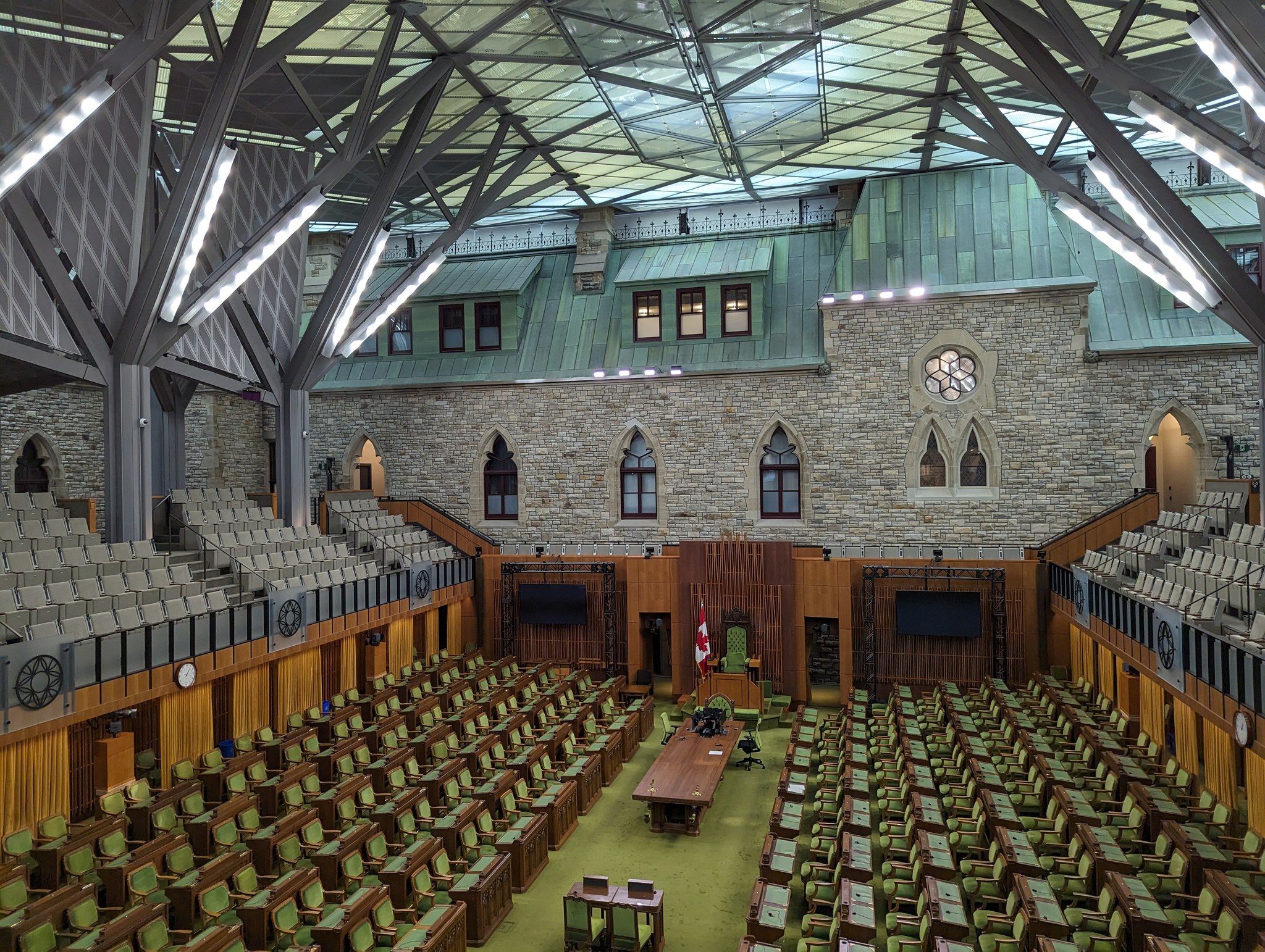
Featured photo: The House of Commons chamber in the West Block on Parliament Hill, Ottawa, September 2023. Photo: Takipoint123 / Wikimedia Commons, CC BY-SA 4.0 (resized).
Claire Bastien covers Parliament and its Indigenous affairs committees for Tewatati.