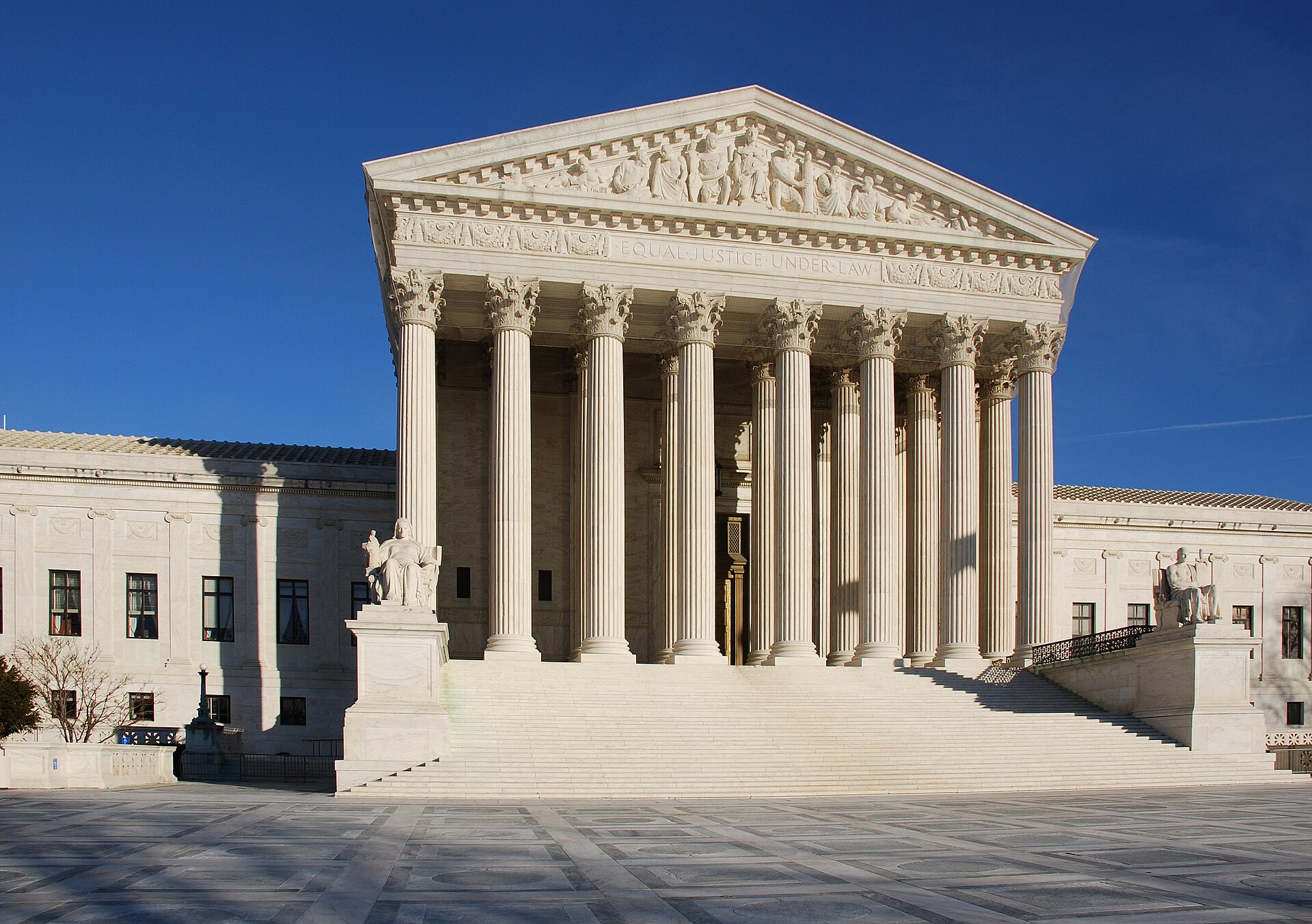
The front facade of the U.S. Supreme Court Building. Photo: Jarek Tuszyński / Wikimedia Commons, CC BY-SA 3.0.
ANALYSIS: This article interprets recent court actions and their likely implications.
The U.S. Supreme Court on Oct. 5 declined to hear N.R. v. Ellison, No. 25-1287, a petition that challenged both the federal Indian Child Welfare Act and Minnesota’s state counterpart, the Minnesota Indian Family Preservation Act, on equal protection and First Amendment grounds.
The denial came in a long list of orders on the first day of the term. The justices also turned away petitions in Wilton Rancheria v. Unite Here, Winckler v. South Dakota and Winnemucca Indian Colony v. United States, according to the National Indian Law Library’s Supreme Court bulletin.
A denial of certiorari is not a ruling on the merits, and it sets no precedent. But for tribal nations and child welfare advocates, it matters: It leaves the lower-court outcome in place and leaves one of the most consequential questions in federal Indian law unanswered, at least for now.
The question Brackeen left open
Three years ago, in Haaland v. Brackeen, the court upheld ICWA against a sweeping constitutional attack. Writing for a 7-2 majority on June 15, 2023, Justice Amy Coney Barrett held that Congress had the authority under Article I to enact the law. Justices Clarence Thomas and Samuel Alito dissented.
On the most explosive claim, that ICWA’s preferences for placing Native children with extended family, other members of their tribe or other Native families amount to racial discrimination, the court did not rule. It held that none of the parties before it had standing to raise the equal protection argument, or the challenge based on the nondelegation doctrine.
That holding was a procedural door left ajar. Opponents of ICWA have since searched for plaintiffs who could clear the standing bar. N.R. v. Ellison was one attempt, and it added a First Amendment theory and a challenge to a state law modeled on and expanding ICWA’s protections.
Why the equal protection claim matters so much
The legal foundation of ICWA, and of much of federal Indian law, is that “Indian” is a political classification, not a racial one. Tribal citizenship reflects membership in a sovereign nation that has a government-to-government relationship with the United States. The Supreme Court endorsed that view in Morton v. Mancari in 1974.
If the court were ever to hold that ICWA’s placement preferences are race-based, the reasoning could reach far beyond child welfare, potentially threatening Indian Health Service eligibility, tribal employment preferences and other laws built on the same premise. That is why tribal nations have treated every equal protection challenge to ICWA as a challenge to sovereignty itself.
Supporters of the challenges, including some foster and adoptive families, argue that the law can delay permanent placements for children and disadvantages non-Native families seeking to foster or adopt them. Those concerns have been raised in good faith, and they have driven the litigation since before Brackeen. The counterargument, from tribes and from the major child welfare organizations that have backed ICWA, is that the law reflects decades of evidence that keeping Native children connected to their families and nations produces better outcomes.
States are moving, too
The Minnesota law at issue in N.R. is part of a broader trend: States have been enacting their own versions of ICWA, in part as insurance against a future Supreme Court ruling that weakens the federal statute. The court’s decision not to hear the case leaves those laws in force.
What to watch
The court’s docket still includes Indian law petitions. The justices on Oct. 5 invited the solicitor general to file a brief expressing the views of the United States in Teck v. Confederated Tribes of the Colville Reservation, according to the NILL bulletin, a step that often signals interest. Petitions involving the Shoshone-Bannock Tribes are also pending.
For ICWA, the lesson of the past three years is that the law’s opponents are patient. Tribal nations and their allies should be, too, and should continue to build state-law protections and tribal court capacity that do not depend on the views of nine justices.
Sources: SCOTUSblog; National Indian Law Library; Haaland v. Brackeen opinion.