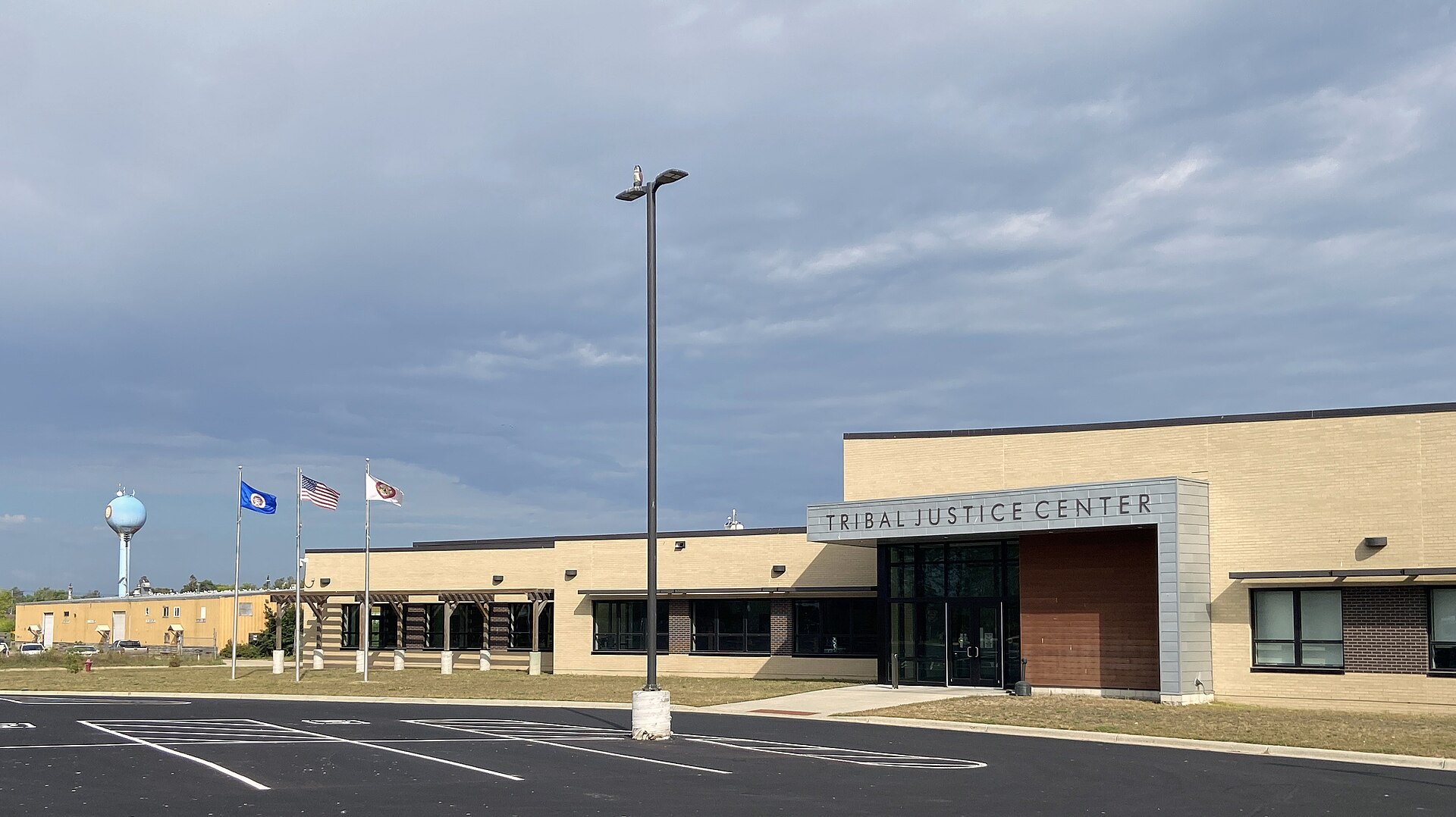
Flags fly outside the Tribal Justice Center of the Leech Lake Band of Ojibwe in Cass Lake, Minn. (2023). Photo: Myotus / Wikimedia Commons, CC BY-SA 4.0.
When a county judge in South Dakota or Nevada signs a search warrant for a suspect’s text messages, the phone company is required to comply. When a tribal judge a few miles away signs the same kind of warrant, federal law does not require the company to answer at all.
A bill to close that gap is one vote from the president’s desk. The Tribal Access to Electronic Evidence Act, S. 1574, passed the Senate by unanimous consent on Sept. 29 and has been “held at the desk” in the House since Oct. 5, according to the record of actions. The House has taken no further action and does not return for legislative business until Nov. 9, after the midterm elections.
“Despite facing high rates of violence, Tribal communities are denied access to essential tools needed to solve crimes,” Sen. Catherine Cortez Masto (D-Nev.), the bill’s lead sponsor, said after the vote, according to her office. “It’s past time for Congress to eliminate this hurdle for Tribal law enforcement. I applaud the Senate passage of this legislation, and I urge my House colleagues to immediately send it to the President’s desk.”
A court left out of the statute
The obstacle is the Stored Communications Act, passed in 1986 as part of the Electronic Communications Privacy Act. It bars providers of email, phone, social media and cloud services from handing over customers’ stored communications, with exceptions for governments that obtain a warrant, court order or subpoena from a “court of competent jurisdiction.” That definition covers federal courts, state courts and military courts. It does not mention tribal courts.
The bill’s fix is short. It would add “a Tribal court” to the list of courts of competent jurisdiction and add Indian tribes and their political subdivisions to the definition of “governmental entity.” It defines a tribal court as “a court of general criminal jurisdiction of an Indian Tribe authorized by the law of that Indian Tribe to issue search warrants,” and limits eligible tribes to those on the Interior Department’s list of federally recognized tribes.
Warrants for the contents of communications would have to be issued using procedures that comply with the Indian Civil Rights Act of 1968, which bars tribes from issuing warrants “but upon probable cause, supported by oath or affirmation, and particularly describing the place to be searched and the person or thing to be seized.” The text also adds tribal courts to the statute’s delayed-notice provisions.
The National Native American Bar Association, the National American Indian Court Judges Association and the National Native American Law Enforcement Association have endorsed the bill. Its cosponsors are Sens. Mike Rounds (R-S.D.), Markwayne Mullin (R-Okla.), Tina Smith (D-Minn.) and Alan Armstrong (R-Okla.).
What tribes have been asking for
Tribal leaders describe the gap in practical terms. “The Colville Tribes’ law enforcement agency has long been hampered by the omission in federal law that does not allow our tribal courts to compel social media companies to turn over information necessary for our officers to investigate crimes,” Jarred-Michael Erickson, chairman of the Confederated Tribes of the Colville Reservation, said in June 2025, when a House bill containing the same provision was introduced, according to Rep. Rick Larsen’s office. The change, he said, would “allow investigations to proceed faster and more efficiently.”
Without that authority, tribal investigators generally must route requests for such records through federal or state partners, according to a summary of the bill by The Lobby. Rounds framed the bill as removing that dependence. “Cutting out the red tape and allowing Tribal courts to access evidence on their own is a step in the right direction to making every community safer,” he said after the Senate vote.
The proposal grew out of the federal response to the crisis of missing and murdered Indigenous people. The Not Invisible Act Commission, created by a 2020 law that Cortez Masto sponsored, told Congress in its 2023 final report, Not One More, that the Stored Communications Act “does not currently include Tribal courts, thus inequitably withholding from Tribes a necessary and essential tool in today’s electronic world.” It recommended that “Tribal courts must be included in the Stored Communications Act, just as military courts were added recently, to ensure expedited and warranted access to phone and social media records.”
Cortez Masto’s office says the Trump administration removed that report from the Justice Department’s website; a copy remains on the Bureau of Indian Affairs site.
A question of recognition
The bill would not expand whom tribes may prosecute or for what. It does something more basic: it requires federal law to treat a tribal court’s warrant as the order of a court. For nations that, since the 2022 reauthorization of the Violence Against Women Act, can prosecute non-Native defendants for crimes including sexual violence, sex trafficking and stalking, that recognition is not symbolic.
The measure has moved slowly. Cortez Masto and Rounds first introduced it in July 2024 and again on May 1, 2025, after which it sat in the Senate Judiciary Committee for 17 months.
The House calendar
In the House, the same Stored Communications Act language is part of the broader PROTECT Act of 2025, H.R. 3773, introduced June 5, 2025, by Larsen (D-Wash.) with Reps. Ryan Zinke (R-Mont.), Marie Gluesenkamp Perez (D-Wash.), Dan Newhouse (R-Wash.), Tom Cole (R-Okla.), Jeff Hurd (R-Colo.) and Mike Simpson (R-Idaho). That bill would also extend special tribal criminal jurisdiction to drug trafficking and certain firearms offenses, and it was referred to the House Judiciary and Natural Resources committees.
Because S. 1574 is being held at the desk rather than referred to a committee, House leaders could bring it to the floor directly. But the lame-duck session will offer at most five legislative weeks, crowded by government funding and the annual defense bill, according to a preview by Harbinger Strategies. If the House does not act before the 119th Congress ends, the bill dies and must be introduced again.
Requests for comment sent to press contacts listed for Sen. Cortez Masto’s office were returned as undeliverable. The office of Sen. Mike Rounds, the National Congress of American Indians, the National American Indian Court Judges Association, the National Native American Bar Association, the National Native American Law Enforcement Association and the National Indigenous Women’s Resource Center did not respond to requests for comment by publication time.