By Graham Doucette, Tewatati
The Yukon government is asking the territory’s Supreme Court to dismiss a lawsuit from Tr’ondëk Hwëch’in, arguing it did not have to consult the First Nation before changing mining rules in 2025 to let placer and quartz operators keep working under expired permits.
In a statement of defence filed Oct. 1, CBC News reported, the territory says it took “necessary and proper legislative actions” and that while “in certain circumstances, Yukon owes a duty to consult,” that duty is not “triggered or owed” to Tr’ondëk Hwëch’in “in the legislative process.” It says it “at all times had adequate staffing and resources” for the assessments.
The defence also argues the First Nation waited too long to sue, denies that it suffered damages, and says its participation in two territorial working groups on mining legislation undercuts its request for declarations. According to APTN News, the government says it authorized developments “having full regards to impacts on the (First Nation’s) rights and interests,” denies it saved money, and argues that any infringement would be justified as “being in the pursuit of compelling and substantial public objectives.”
Tr’ondëk Hwëch’in filed a reply on Oct. 13, arguing that “no working group” has dealt with the amendments and that the government “does not come to the Court with clean hands,” CBC reported. None of the allegations on either side has been tested in court, and the case has not gone to trial.

What changed in 2025
On May 29, 2025, the territory made temporary amendments to the Placer Mining Land Use Regulation, the Quartz Mining Land Use Regulation and the Waters Regulation. The changes let eligible operators keep working under expired or expiring approvals while they waited for new ones. The government said about 50 placer mining projects and four quartz exploration projects had reapplied. It blamed the backlog in part on a 10-year authorization cycle that brings a wave of renewals every decade.
“This is a temporary measure while the current regulatory backlog is resolved,” then-Energy, Mines and Resources Minister John Streicker said at the time. The government said extensions would apply only to projects that had already been through First Nations consultation. The amendments run until Dec. 31, 2028, according to CBC. In a statement to Tewatati, the Government of Yukon said the temporary measures apply only to permits that expired before Dec. 31, 2026, and that activities are authorized only where a YESAA decision document “contemplates the temporal scope of the activities.” It said “First Nations are participants in the environmental assessment process” and that it consults First Nations when issuing decision documents.
The First Nation’s case
Tr’ondëk Hwëch’in, based in Dawson City, filed its 17-page claim on Jan. 28. It says it learned of the amendments the day they were made. The claim says Yukon failed to staff up for a “foreseeable surge” of renewals, even though a similar surge occurred in 2014 to 2016, and that some extended projects are on Settlement Land, where the First Nation is a decision body under the Yukon Environmental and Socio-economic Assessment Act.
In its Jan. 29 release, the First Nation called the amendments “a blunt regulatory band-aid that puts the risk on the environment and our treaty rights and interests.” It noted that the effects of the extended activities were reviewed more than 10 years ago and that conditions have “substantially changed” since then.
“Placer mining is an important part of the Dawson City economy and many of our citizens work in the industry. But mineral activities within our Traditional Territory cannot come at the expense of our treaty rights and interests,” Hähkè (Chief) Darren Taylor said. “YG’s conduct is dishonourable and unbecoming of our treaty partner. It also pits First Nations and industry against each other, which harms, rather than advances, the process of reconciliation.”
The First Nation is seeking declarations that Yukon breached its duties under the Final Agreement, damages, and repayment of any money the government saved by not hiring staff.

The legal question
The “legislative process” argument echoes the Supreme Court of Canada’s 2018 decision in Mikisew Cree First Nation v. Canada, which held that the duty to consult does not apply to Parliament’s law-making. In a summary of the ruling, the Indigenous rights firm JFK Law notes that the court’s reasons said that conclusion does not extend to the making of regulations, which is executive rather than parliamentary conduct. The amendments at issue in Yukon are regulations. How the court will treat Yukon’s argument is not yet known.
Politics of the backlog
The Yukon Party government, elected in fall 2025, is now defending the suit. Energy, Mines and Resources Minister Ted Laking told the Yukon News in January, “We need to also ensure that we’re doing everything to meet our obligations to consult with affected First Nations.” In June, he told CBC the government was issuing a permitting decision document “every second day.”
Riverdale North MLA Carmen Gustafson of the Official Opposition New Democrats said in January that a mining announcement by Laking was “in stark contrast to the reality on the ground in the Yukon,” pointing to the First Nation’s suit. Jonas Smith, executive director of the Yukon Chamber of Mines, told the Yukon News permits had taken “longer and longer” as the government consulted First Nations under “various court-dictated processes and precedents.”
Tr’ondëk Hwëch’in has a separate lawsuit against Yukon over mineral claims staked on its Settlement Land before its Final Agreement was signed.
Asked why it takes the position that it owed Tr’ondëk Hwëch’in no duty to consult, the Government of Yukon told Tewatati: “The legal basis for the position taken by the Government of Yukon in its statement of defence will be argued before the court if and when this action comes to trial.” It said it “is working with Yukon First Nations on new minerals legislation” and “will work with Yukon First Nations as changes are contemplated” to permitting processes.
Tr’ondëk Hwëch’in; the Klondike Placer Miners’ Association; the Yukon Chamber of Mines; Gustafson; and the Yukon Conservation Society did not respond to a request for comment by publication time.
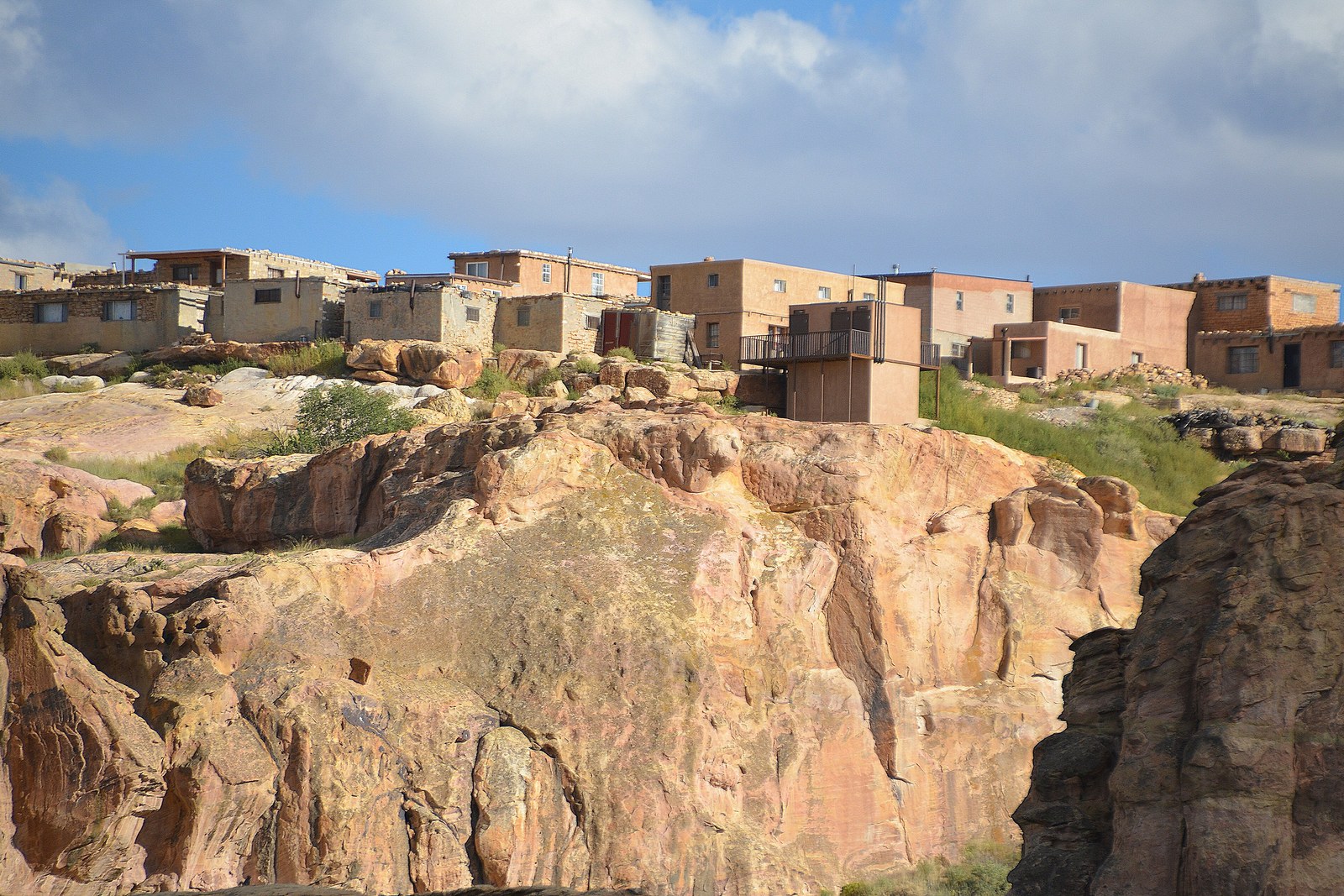
Tr’ondëk Hwëch’in’s Dänojà Zho Cultural Centre in Dawson City, Yukon, September 2019. Photo: sf-dvs / Wikimedia Commons, CC BY 2.0 (cropped and resized).
Graham Doucette covers First Nations and Canada for Tewatati.