By Henry Calloway, Tewatati
This is Part 1 of “Section 106 Under Pressure,” Tewatati’s series on proposed changes to the National Historic Preservation Act and what they would mean for Tribal Nations.
For six decades, Section 106 of the National Historic Preservation Act has required federal agencies to weigh how their projects affect historic places and to consult Tribal Nations about places important to them. A Senate permitting bill now eight days from its first floor test would write a new, narrower version of that process into federal law.
The bill is S. 5653, the Bipartisan American Affordability and Jobs Act of 2026. It was introduced Sept. 30 by Energy and Natural Resources Chair Mike Lee (R-Utah) and ranking member Martin Heinrich (D-N.M.), with Environment and Public Works Chair Shelley Moore Capito (R-W.Va.) and ranking member Sheldon Whitehouse (D-R.I.). The preservation changes are in Division B, Title III.
The vote on Nov. 9
Under a unanimous consent order printed in the Senate Calendar of Business, the Senate is set to vote at 5:30 p.m. ET on Monday, Nov. 9, on cloture on the motion to proceed to H.R. 2347. That House-passed bill is the vehicle for the permitting package, according to Roll Call. Ending debate on the motion takes 60 votes.

What Title III would change
What counts as sacred. For the first time, the statute would define a “property of traditional religious or cultural importance” as “an identifiable geographic location or feature at which an event of continuing religious or cultural significance to a living community occurred.”
Fewer reviews. An “undertaking” would require a federal permit, license or approval and “substantial Federal control.” Projects whose only federal involvement is a grant, loan or other financial assistance would be excluded.
Consultation on a clock. Agencies “may consult” Tribes when identifying historic properties. If a Tribe or Tribal Historic Preservation Officer (THPO) does not respond within 30 days, the agency “shall proceed,” and on re-entry it “may consult with the Council in lieu of” the Tribe. Agencies could decline mitigation when, “in the sole discretion of the applicable Federal official and as otherwise allowed by law, other considerations outweigh the consideration of historic preservation.”
Oversight of Tribal offices. Interior would evaluate each Tribal program at least every two years. A program is not consistent with the law if its THPO “does not regularly comply with timelines for consultation, complete consultation expeditiously, or meet required metrics.” After two years without a cure, the Secretary “shall assume all or part of the functions of the Tribal Historic Preservation Officer.”
Courts. Judges would give “substantial deference” to agencies. When a court finds a violation, “the only remedy” is a remand “without vacatur or issuance of an injunction.”
Money. The bill authorizes $200 million a year for the Historic Preservation Fund through 2036 and $20 million a year through 2030 for THPO grants to build databases of sacred places.

The sponsors’ case
At an Oct. 29, 2025 committee hearing, Lee said “a narrow procedural safeguard has evolved into a sprawling, unpredictable process that now delays some of the very projects our country needs to build.” Heinrich has said the bill gets “to ‘yes’ or ‘no’ on energy projects faster, while protecting important environmental safeguards and protecting the ability of Tribes to formally consult during these processes.”
The Advisory Council on Historic Preservation (ACHP) voted in July to advance a rewrite of its Section 106 rules, and the draft has been under White House review since July 28. It has not been published. The Institute for Progress, which backs the bill, says the draft would exclude “mountains, valleys, bodies of water, or landscapes,” and that the bill would put consultation protections into statute that a rule cannot change. IFP also concedes that the bill “does narrow Section 106 in other ways.”
Why Tribal Nations want Title III struck
Nine Tribal organizations wrote to Congress Oct. 9 asking that the title be withdrawn. They acknowledged “some positive provisions, including the codification of Tribal consultation and an increase in the Historic Preservation Fund,” but called the federal takeover of THPO functions “deeply paternalistic.” The Native American Rights Fund’s analysis says “Mandatory Section 106 consultation is eliminated and becomes permissive and time-boxed.”
At its convention in Palm Springs, the National Congress of American Indians’ General Assembly adopted a resolution calling on Congress “to withdraw the Title III of S.5653 and to work directly with Tribal Nations and THPOs.”
The National Association of Tribal Historic Preservation Officers (NATHPO) answered Tewatati’s questions in writing, through Valerie Grussing, its executive director for legislative affairs and strategic partnerships.
“The idea that the federal government could unilaterally take over an entity of a Tribal Nation is nothing short of an assault on Tribal sovereignty,” NATHPO said. The most harmful change, it said, “is the way in which it gives the federal government the authority to decide what makes a place sacred to a Tribal Nation.”
NATHPO rejected the argument that the bill shields Tribes from the rule. “BAAJA does exactly the opposite of what Sen. Heinrich and the bill’s supporters say it does,” it said, referring to the bill by its initials. “Instead of preserving the requirement to consult currently enshrined in the National Historic Preservation Act, BAAJA makes it optional.” Unlike a change at the ACHP, it added, the bill “would be enacted into law and require an Act of Congress to undo it.”
Jessie Barrington, a citizen of the Confederated Tribes of Coos, Lower Umpqua, and Siuslaw Indians who chairs the Tribal Nations practice at Cultural Heritage Partners, part of the 106 Strong coalition, rejected the choice between bill and rule. “The ACHP rule is bad, and we are fighting it. But it is still an unpublished draft,” she told Tewatati in an emailed statement. “Title III would put much of that same narrowing into federal law, where only Congress can take it back.”
“In some ways the bill is worse than the rule,” Barrington said. “The draft rule gives Tribes 60 days to respond to agency findings, and the bill gives them 30.” She added: “Tribal Nations should not have to pick the lesser of two harms. Congress should strike Title III and start over, with Tribes at the table from the first draft.”
Barrington also noted that the bill’s funding figures are authorizations, not guaranteed money. By her math, the $20 million a year in THPO grants, split among about 235 offices, would come to at most about $85,000 per office, less than the roughly $104,000 per office THPOs received in fiscal 2024.
Barrington said 106 Strong plans a rally at 12:30 p.m. ET on Nov. 9 at Union Square near the Capitol Reflecting Pool, followed by visits to Senate offices.
Ben Schifman of the Institute for Progress replied after Tewatati’s original deadline and offered to comment; that comment was not available by publication time. The National Congress of American Indians; the Native American Rights Fund; the offices of Sens. Lee and Heinrich; and the ACHP did not respond to a request for comment by publication time.
Part 2, on Nov. 3, looks at the Tribal historic preservation offices the bill would put on a federal clock.
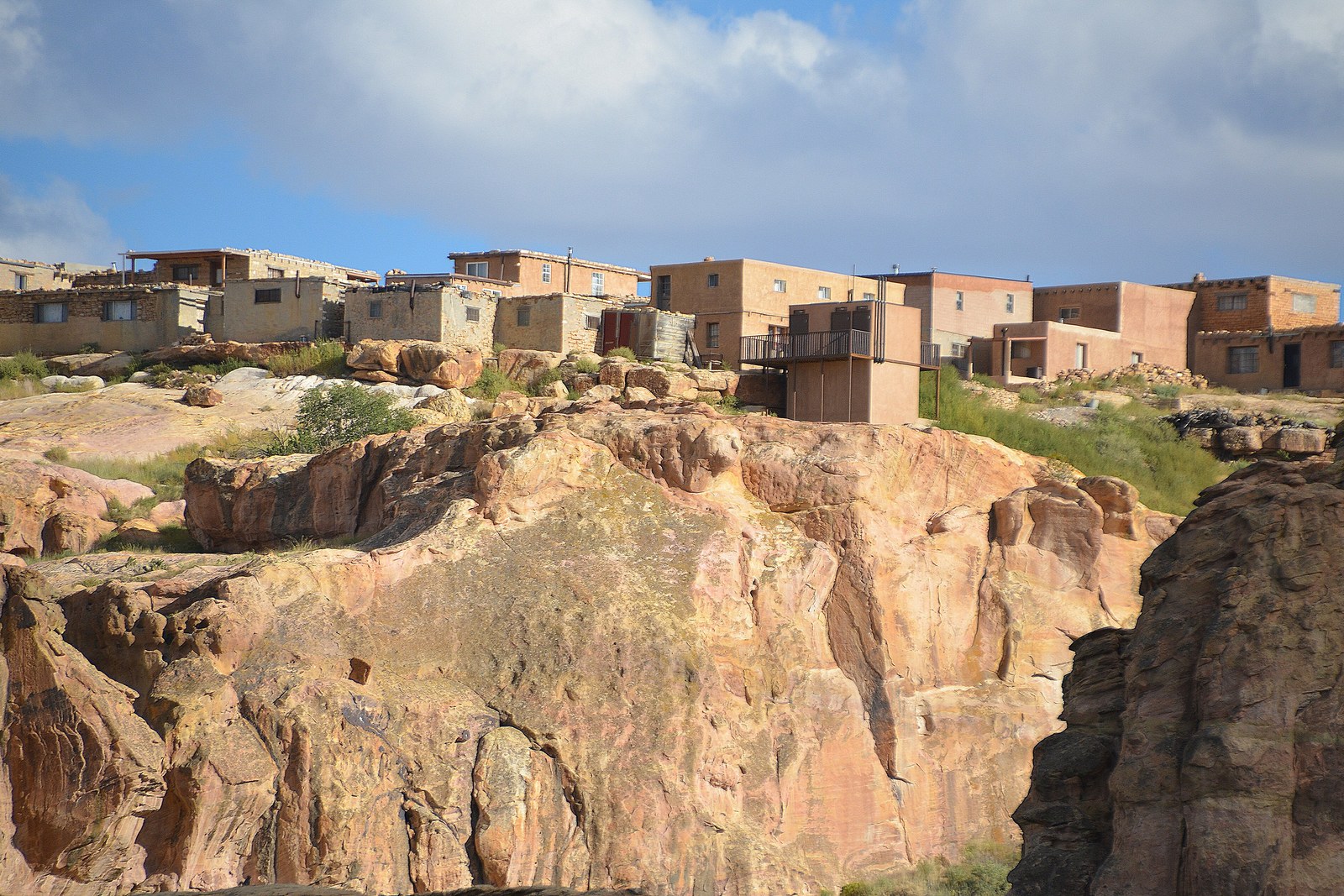
Sky City at the Pueblo of Acoma, New Mexico, September 2017. Photo: NewMexicophotographer1 / Wikimedia Commons, CC BY-SA 4.0 (cropped and resized).
Henry Calloway covers Congress and its Indian affairs committees for Tewatati.